Monday, February 29, 2016

February 2016

In which we end our winter tour of the Canaries, finishing up where we started.

We started February anchored off Montana Roja, Tenerife.  A nice, sheltered anchorage and it needed to be as a strong NE’ly wind blew for several days reaching F9, over 40 knots at times.  Books were read and I even managed to make a little progress with my Spanish.  The main beach was deserted but a little one tucked in the corner had its daily visits by hardy sun seekers.  There were also the occasional wind- and kite- surfers.  One of the latter gave us a minor drama one lunch time.  We watched him try, and fail, to get going after falling off and, after the 5th attempt decided that he wasn’t going to succeed and, as he was drifting towards South America, thought that we ought to do something.  We had started the engine and were about to heave up when the official rescuers from around the headland at Medano arrived on a jetski towing an inflatable tender.  Sheepish surfer returned to the beach.  That night, a SAR helicopter conducted a lengthy search operation in the area but we believe this was an exercise as there was nothing on the marine VHF or Navtex requesting assistance.

On the 4th, supplies were running low and the wind abated, so we decided to return to La Gomera.  We had a good start, running under just the genoa but, once more had to motor for a while before picking up a light northerly which brought us back to St Sebastian.  Theoretically, the parts for our headsail furling system should have arrived but we got increasingly strange messages as to their whereabouts. It transpired that, although the Canaries are happy to be part of the E.U. when it comes to grants for major projects, they are outside when it comes to imported goods.  They eventually arrived but I had to pay an additional 32 Euros: 23 to open the file and 9 excise duty, charged not only on the parts but also on the transport cost.  Theoretically, we could claim this back but the local official just scowled and went back to more important paperwork.  Having got the parts, fitting was a breeze and, for the first time, we were able to deploy and furl the genoa without using a winch (in light airs, at least).


                                                 Up the mast

We had returned in time for the local Mardi Gras Carnival.  Not quite on Rio’s scale but great fun.  Although there were daily visits by cruise liners, these were booted out before nightfall, allowing the locals to enjoy themselves without being swamped by tourists.  On Friday evening was the ceremony to pick the carnival queen.  The candidates had made incredibly intricate costumes, some mounted on lightweight gantries which they towed around the stage.  Most of the evening was taken up with musical groups.  These were of variable quality but equal enthusiasm.  Seemingly, to qualify for performance, each song has to mention ‘carnival’ in each verse and ‘La Gomera’ in the chorus.  Our favourite was the wonderful ‘Tronchi Ponchi Monchi’ group, who interspersed singing with the playing of trumpet shaped kazoos. 


                                         Carnival Queen.  She is towing this structure.

Saturday was the grand parade with grand floats, singing groups and drum bands.  Carnival queens, senior and junior were towards the front, with runners up following.  Every float appeared to have catering on board and at the tail of the procession small groups in fancy dress pushed covered supermarket trolleys.  The reason for this became apparent later.  Following the parade there was a gap of a couple of hours when each group had a picnic supper before the carnival ball, which went on until 5 AM.  We know the time not because we were present but because it was open air and only 100 meters from the Marina.  They even managed to drown out the noise from the generators on the ubiquitous ARMAS ferry.

Sunday was a rest day but Monday saw the talcum powder parade where everyone, wearing white, saunters through the town puffing talc in the air and on friends old and new.  The theme is continued into the evening with the talcum powder ball – a repetition of Friday’s dance but rather whiter.  We joined in, stripping off on deck on return and hosing down the following morning.


                                                                   Before


                                                                   After

Although it meant missing Friday’s ‘Internment of the Sardine’ (truly), we decided to move on on Wednesday and set off round the North of Gomera back to La Palma.  A spirited start into a NNW’ly F6, followed by a cracking beam reach with NE’ly F4 across to Santa Cruz.  The motion in the marina was as bad as before but we wanted to see the town so stayed 2 nights.  Santa Cruz, once away from the harbour, high rise hotels and MacDonalds is a very pleasant town still with local character among the tourist orientated shops.  The Carnival had obviously hit here too as the streets, cars, and shopfronts were covered in talc.  This meant that footing on steep, talc covered cobbles was somewhat precarious in places.

We had had enough rocking around by Friday and set off, once more, for Tazacorte.  Again, we went down the East coast, this time with just the genoa in a following F5-6.  This followed us round the bottom and we only had to motor a mile or so before finding a NNW’ly F2 which took us gently back to Tazacorte.

On our previous visit, we had identified a walk in the Tambuirente caldera, where you take a taxi to the top and walk down.  We had even done the first mile and back to ensure that it was suitable so on Saturday morning we took a bus up to Los Llanos and 2 taxis up to the top viewpoint.  The first 5 Km, descending gently through pine forest, was very picturesque.  The guidebook suggested 1.5 – 2 hours and we managed it in 1h 35mins so felt we deserved our picnic before the 7 Km leg.  This, it was suggested, would take 4 hours.  It was soon apparent that this trail was somewhat more challenging.  The first part (once we found it) took us down a steep path with hairpin bends to the valley floor and a dry(ish) river bed.   Unfortunately the bed was blocked at intervals by rock falls, necessitating scrambles on rocky diversion paths.  It was a footsore duo who emerged at the bottom car park 3h 55mins later.  Fortunately, there was a sign giving the number for a local taxi company and we splashed out on getting him to take us back to the boat.  On writing, 2 weeks later, we still have bruised toes from descending 3000 ft.  

We stayed in Tazacorte for a further week doing a little light maintenance, a little sun bathing and a little eating and drinking with the occasional walk up to the main village for provisions.  I still failed to persuade Elsie to visit the banana museum so we have an excuse for returning.


It was time to start thinking of moving on and back to mainland Europe.  There were forecasts of 2 periods of wind from the north, starting on the 21st and 26th respectively and we decided to take advantage of this by making two overnight passages: first to Santa Cruz de Tenerife and then to Lanzarote.  We departed Tazacorte at 0945 on the 21st and alternately motored and sailed up to the north of the island where we would find a nice F3 to take us across.  Not so.  We would have been content with the speed that the actual F2 gave us but, being beam on to the swell, we just rolled too much to keep the sails full and they slapped and banged so it was motor 6 hours; sail 6 hours and arrived at Santa Cruz at 1130 on the 22nd.  A nice marina, convenient for the city centre (or it would be, if the footbridge hadn’t been closed due to construction work).  Part of the reason for coming here was to solve a long running problem with the radar: the book says that it will work down to 8.7 volts, but it had been cutting out as high as 12.5V, easily reached on a long passage.  After much probing, we believed that it was caused by a voltage drop inside the chart plotter and had found the man who not only understood the system, but had the tools.  It turned out that the cause was two-fold.: poor design, in that there was a voltage drop inside the plotter (and it was inherent, checked by temporarily replacing PCBs); and poor installation, in that there was an excessive run of too small gauge of wire.  We managed to buy and run some suitable cable ourselves to get round the second part of the problem but Jose didn’t have time to connect it up for us so we still have yet to get it properly working.


                                    Snow on Tiede, Tenerife

The second leg of the passage, from Tenerife to Lanzarote, we too much rather than too little wind.  Leading up to departure, the forecast had increased from F4 to F6 but we actually encountered F7, inevitably during Elsie’s watch in the middle of the night.  Having become used to bumbling about the islands, we had become a little blasé about passage preparation and left the dinghy lashed on deck.  It got moved by a wave and we lost the seat overboard.  Lesson learned.  I also managed to break the oven door handle by grabbing it when rolling so have the entertainment of obtaining parts to be sent out to us.  The wind, although stronger than forecast, was from a good direction and we managed to achieve the perfect place for springing off on our next passage up to Madeira: la Graciosa, the small island at the northern end of Lanzarote.  Here we stayed, at anchor for the next few days with the forecast of getting a nice beam wind to take us up.

Monthly stats:
Logged  408

Over ground  404   

Sunday, January 17, 2016

January 2016

In which we explore the western isles of the Canaries.

We started 2016 at anchor off Puerto de Vueltas, La Gomera.  We had already decided that we liked the look of the island from our visit to San Sebastian and our views from offshore.  Despite no hire cars being available in the Capital, we managed to find one here and took it for a couple of days.  It being a very small island (about 15 miles in diameter) and mostly wilderness, we managed to drive just about every available road.  Since many of them run from the coast to the central plateau, about 4000 ft AMSL via many hairpin bends, we covered about 300 km.  It certainly is beautiful, with none of the high rise resorts, theme parks and MacDonalds found on the larger islands.  Our favourite village was Alajero, halfway up the slope on the southern side with fantastic views over the ocean.  A small church on a spur had been visible as we cruised along the coast and fascinated Elsie.  Close by is a dramatic four sided cliff formed by the erosion around a volcanic extrusion.  It had apparently been used as a place of refuge by the natives when Moorish pirates came raiding.


La Fortaleza

On the 3rd, we decided it was time to move on and headed North West to La Palma.  With  NE 4 on the beam, we made good time across until we got to the southern tip where the usual blanketing killed the wind and we had to motor the last 13 miles up to Tazacorte, pausing for a brief dip at anchor of Puerto Naos (confusingly, there are many places named Puerto with no vestige of a port).  Tazacorte does have a large port, built to take RoRo ferries which never arrived, but it does provide excellent shelter for a modern marina.  The old port has been converted into a bathing beach, the most sheltered that we have found on either La Palma or Gomera.  Looking ahead, there would be a sailing wind on the Tuesday and Wednesday, then nothing for a week so we decided, rather than explore now, we would sail round the top of the island to the capital, Santa Cruz.  The first 15 miles were a motor into wind but we then had a fine, if wet, sail round for the final 25.  The NE trade wind brought in a damp airflow to give us our first proper rain in over 2 months.  We thought of asking for sympathy from our friends back in Aberdeenshire but as they were suffering the worst floods in 150 years, decided not.  Santa Cruz is reputed to be very pleasant, once you get behind the initial row of tourist hotels but, as it was still raining, we did not venture out of the marina past the new MacD’s.  We had thoughts of sailing on to El Hiero on Wednesday, but there was no clear prospect of returning on the forecast wind so instead we continued on our clockwise circuit of la Palma.  A NE’ly F4-5 gave us a fantastic sail broad reaching down the east coast, although I enjoyed it more than Elsie, who was rather tight lipped after I rejected her suggestion of a second reef, shortly before hitting our peak speed of 10.5 knots.  She was consoled a little by the largest pod of dolphins we have ever seen.  There must have been over a hundred, racing along and leaping clear of the water.  An uplifting sight.  Round the southern tip of the island, the wind again died but, this time, then changed to a usable SW’ly to take us back up to Tazacorte.  This was the 12th day of Christmas, 3 Kings Day in Spain so, as there would be no staff on duty at the marina, we tried the unofficial anchorage at the entrance.  This proved very comfortable but, with a few local boats moored, space is limited.


 We re-entered the marina next morning and made enquiries for car hire.  The only local provider was closed and the nearest available was a bus ride away and had a minimum hire period of 3 days.  We wanted to explore and took the only car available, a VW Polo automatic.  I have always been wary of small automatics but this one, with a 1.4 engine and a 7 speed ‘box, proved the ideal vehicle for the tortuous mountain roads, this time going up to 8000 ft AMSL.  There are many micro-climates on the island, making it difficult for a visitor to work out where it will be sunny and where there will be thick cloud / fog but we managed to guess right most of the time with just the exception of a damp lunch at Puerto Vueltas on the 3rd day.  More spectacular views than can be listed, especially around the huge volcanic caldera that dominates the north of the island.  On the northern lip of this is an observatory, taking advantage of the high altitude and dark skies.  Amongst many optical telescopes, hidden in their domes, are a pair of Gamma Ray ‘scopes, with polished mirrors parked down-sun during the day.  Most ‘interesting’ drive was the 14 kilometers, climbing 2500 ft along a tiny, winding road up to Los Brecitos, with precipitous drops and no barriers, enlivened by the oncoming taxis and one 30 seater bus coming the other way.  If we visit again, we will take one of the taxis and follow the footpath down.  Better for the heart in at least 2 ways.


MAGIC telescope

We wanted to ‘complete the set’ of Canarian islands and saw our opportunity, with winds forecast to be SE’ly on the 12th – 15th.  So, after a lazy day on the 11th we made an 0430 start towards El Hierro.  Light winds, in the lee of La Palma, meant that we had to motor the first 13 miles but, as soon as we passed the southern tip, we had fine sailing winds on the beam all the way.  El Hierro has no usable anchorages and only 2 ports.  La Estaca is the commercial port, used by the high speed ferry from Lanzarote.  The inner harbour was completely filled with local moorings, with visitors having to tie up to the concrete wall.  The southern port of Restinga has recently been equipped with pontoons so we headed there, partly for easier mooring but also to push as far South as we could (27 38 N).  I had tried on a couple of previous occasions to contact the harbour master, without success, but tried again.  He spoke no English but a helpful German, visiting his office translated that the pontoons were full, there was room on the wall and it had been much improved to make it yacht friendly.  So we continued down and arrived prepared with fender boards, long lines, etc.  We were a little disappointed that we were offered no assistance to tie up but were managing when we noticed a security guard waving at us from the pontoon.  There was a space for us after all (albeit with nasty metal protrusions which required careful fendering).  No car locally but we managed, the next day to catch the bus into the capital and take a round trip on another which past Puerto de la Estaca.  As we came down the hill, blow me, there were beautiful new pontoons, with plenty of spaces.

Having seen as much of El Hierro as we could easily achieve, we set off at dawn on the 14th back to La Gomera.  The forecast was for a SE’ly F3, which would give us a gentle beam reach, but it never developed so we had to motor practically all the way.  We had noticed brightly coloured bubbles on the surface.  A larger one looked like a child's toy, made of clear plastic with red and blue decoration.  We stopped and backed up slowly to it and realised that it was a Portuguese Man-of-War jellyfish.  Gulp.  Must be a bit circumspect with our daily swims. Also saw more pilot whales.


Portuguese Man O'War

As we manoeuvred to anchor off Vueltas, the engine suddenly started belching white smoke and the high temperature alarm sounded.  As the windlass only works with the engine running, there was a quick lower of first 10 meters of chain, stop engine, then drop the rest of the chain on the brake.  This was a bit sticky so, obviously, time for a little maintenance there as well.  Replacing the raw water impeller on the engine (though existing one had 5 of 6 vanes still attached) produced a healthy flow of cooling water and has hopefully solved this problem. Checking round in the night, we saw another freak of nature – thousands of green pipe fish, about 40 cm long just swimming slowly around on the surface and occasionally jumping.  Were we in a spawning ground?  They surrounded us for several hours but were gone in the morning.  To test the engine, we headed out and South in the morning.  Tried sailing for a bit but the wind died so we motored most of the way back to the anchorage near Santiago, this time performing a running moor – dropped kedge anchor; motored ahead; dropped main anchor and heaved kedge in tight.  Worked reasonably well for a first attempt, but managed to foul the kedge with the tripping line, so that it did not set properly and had to be re-laid.  Second time – perfect!


Wall to wall sun on Saturday so a lazy day of light maintenance swimming and sunbathing.  An easy start to Sunday then, after picking up 2 anchors, motor up the coast to San Sabastian, where Elsie was to stay with Ruby while Lionel caught the ferry to Lanzarote and flight to Scotland for routine heath checks.

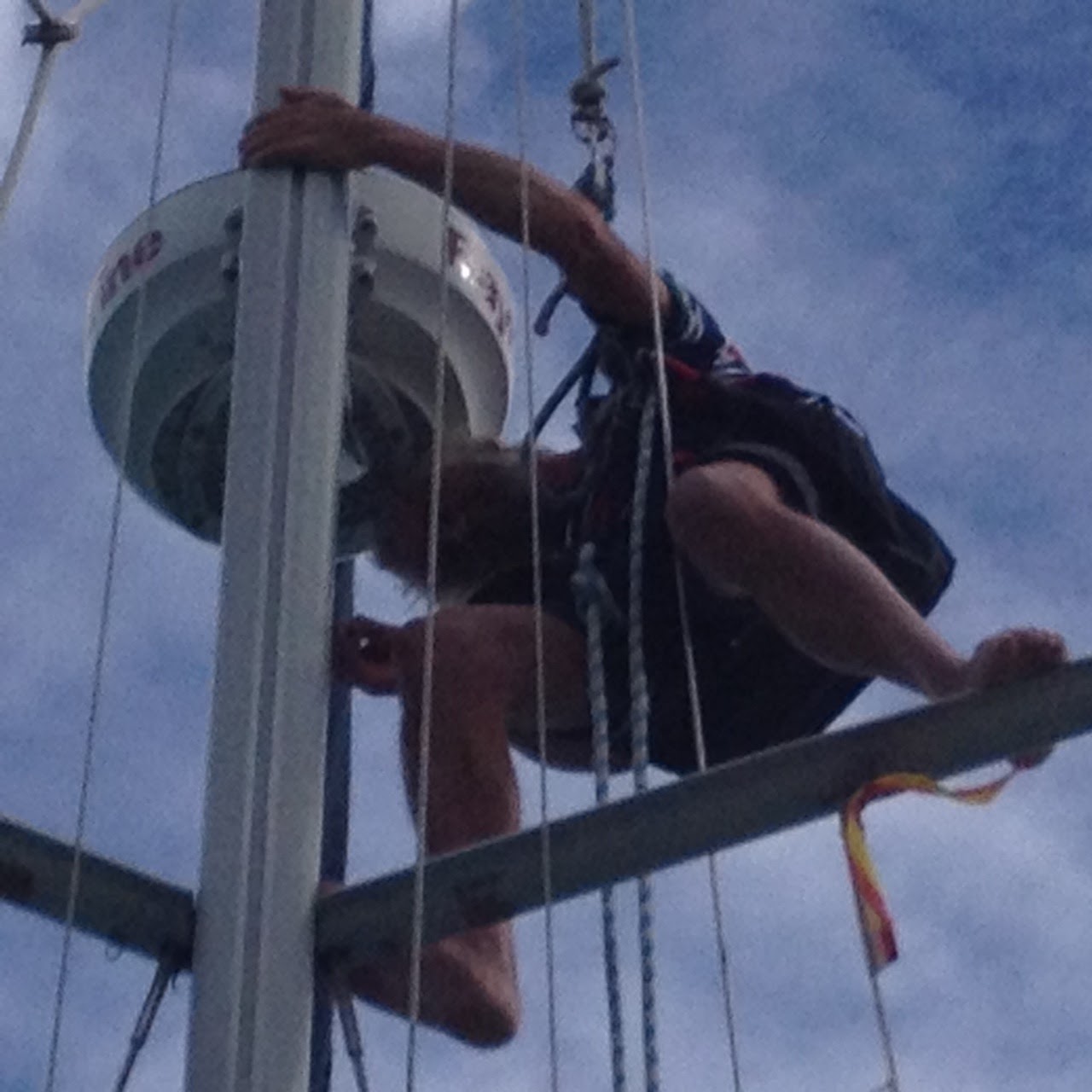
 On return, there were a couple of maintenance tasks to complete, including a look at the headsail furling system, which had been harder than usual to operate on the last leg.  Another trip up the mast revealed that the top bearing was missing.  A phone call to the U.K. agent confirmed that the parts were available and that we should be able to fit them without removing the system from the forestay, which would be a major job.  Since we would have to wait for the parts, it was back to the old dilemma of having to be in a certain place at a certain time.  We could have just waited i n San Sebastian but we felt that we were becoming a fixture.  Plan 'A' was to go back to La Palma, have a proper look at Santa Cruz, and then return to Tazacorte - a perfect place for lotus eating.  The weather forecast, however, suggested that we might again find rain in Santa Cruz so decided to head east to Tenerife instead.  As soon as we confirmed this with the parts supplier, the forecast changed, but we continued anyway.  In theory, we should have had a good beam reach across to the bottom of Lanzarote, followed by a beat into 15 knots up to Montana Rojo.  Instead, we had a light airs crossing, with more motoring than sailing, followed by a motor into a 25 - 30 knot headwind.  We made it to the anchorage and spend a reasonably comfortable couple of days as the wind increased to a full gale which only abated on the evening of the 31st.

Monthly stats:
logged: 289   
over ground284

Thursday, December 17, 2015

December 2015


We started December in Puerto Calero, Lanzarote.  Having, for our current lifestyle, had a hectic week – Elsie doing her Day Skipper practical and me flying to U.K. and back, we planned a chill-out and we knew just the place: La Graciosa.  The anchorage here is in a conservation zone and requires permission.  The system for granting this seems designed to make it almost impossible for the cruising yachtsman who relies on the vagaries of the weather:  application must be made, in writing, at least 10 days in advance on a form available only in Spanish.  Fortunately, I had had time to spare while in Rubicon.  I found the form online; completed it, with the aid of Google translate and sent it to the correct person.  48 hours later – nothing.  So I went to the marina office and the helpful lass picked up the phone and after a 5 minute phone call, 4 ½ minutes of which seemed to be about hair, children and plans for Christmas, she assured me that it was all arranged.


We timed our departure from Calero to get the best winds, which were forecast to be SE’ly F4 from late morning, backing to E’ly in the afternoon.  The directions were fulfilled but it was lighter than forecast so it was late afternoon before we arrived at the Estrecho del Rio, the strait between Lanzarote and La Graciosa.  The wind now veered and increased and, as we passed under the cliffs it was a gusty SSE’ly F6.  This was blowing directly towards the anchorage and we seriously considered continuing west and spending the night safe at sea.  When we arrived at Playa Francesca, however, it had reverted to a light South-Easterly.  The anchorage, which a month before had been full, was now deserted.  Did everyone else know better?  We decided not, though we did put out extra chain on our main anchor and laid a second, just in case.  In fact, it was a very quiet night, with the wind boxing the compass and putting a full twist in our anchor cables.  It then settled from the east and we lay nicely to the kedge anchor for the next few days.  A couple of other yachts, which had been anchored (illegally) under the cliffs when we arrived, joined us the following day, and tourist catamarans visited daily but it was otherwise a very peaceful interlude with the biggest exertion being the afternoon dip, followed by a solar heated shower or, once, a dinghy ashore and 2 mile walk to the local settlement for fresh provisions and an ice-cream.


After 3 days of lotus eating, we headed south again.  Once more, the winds were lighter than forecast but we managed to (mostly) sail down to the capital, Arecife, to spend the night in the new marina, with a stroll round town to finish the day.  Next day, 6th, we made the jump down to Gran Tarajal in the south of Fuerteventura.  A fine sail for the first 50 miles with 15-20 knots just behind the beam.  The wind then died and we had to motor the last 12 miles.  The book says that there is no-one to contact after 1400, so we just motored in and picked a berth, on the pontoon against the southern wall.  As we tied up, we noticed a guard in a hi-vis jacket waving at us and braced ourselves for his visit.  We had, apparently broken 5 rules, including not calling him on VHF; not noticing him waving; berthing on the wrong pontoon and taking a space that could have been used by a catamaran.  I suspect that it was bluster to impress his trainee and, as no catamarans arrived and the motion on his choice for our berth was quite pronounced, leading to one finger being broken off, I didn’t feel too badly.  The Port Captain, when visited the following morning, certainly didn’t seem at all concerned.


Betancuria

We were now a bit stuck.  It was 90+ miles from here across to Gran Canaria, our next destination.  This is too far for a daylight crossing, we didn’t want to arrive somewhere new in the dark and the wind was forecast to die every night for the next week.  Morro Jable, 20 miles to the west, was reputed to very uncomfortable in the current, SE’ly winds.  We managed to console ourselves by sitting in the sun, with a daily walk to town for provisions.  After 3 days, I bumped into a local, who told me that, although the normal pontoons at Moro Jable suffer from the swell, there are others, used by locals, that are more comfortable.  Accordingly, on the 10th, we made the 20 mile trip and the old pontoons were indeed very calm.  We tied up alongside, rather than stern- or bow-to, as the local boats were.  Again, the Port Captain was very relaxed about this and charged us less than 7 Euros a night.  No water or electricity, but still a better bargain than those who, inexplicably chose to anchor in the swell outside, rather than join us.  This time we stayed for 4 days with an afternoon trip across to the standard pontoon to top up water and batteries and one day with a hire car to explore the island.  The western side had areas of great charm, including the old village of Betancuria, but much of it is almost as barren as Lanzarote and doesn’t appeal as a long term destination.  I took advantage of our lack of motion to go up the mast for a couple of jobs, including replacing the TV aerial, which had fallen off a few weeks before.  We now have 60 odd channels, with nothing worth watching.


Monkey up a stick

Finally, on the 15th, we got a forecast of decent winds overnight.  We cast off at 1500 and headed south west.  Once more, we were disappointed with the strength of the wind, achieving 3 – 4 knots through the evening rather than our planned 5 – 6 but we had 24+ hours to make the 80 miles across.  The wind improved after midnight and Elsie got a good sail through her, 0100 – 0600 watch.  We arrived at our destination, Arguineguin, at 0800.  There was, supposedly, an anchorage in the lee of the harbour but, as often happens, this space is now taken by moorings for locals.  We tried anchoring but, where there was shelter there was a rocky bottom, with poor holding and where we managed to dig in, it was uncomfortable in the swell so, after an hour or so, we picked up and continued the couple of miles to Puerto Rico.  This is a tourist resort with a commercial marina.  Not our usual choice but there is, on this coast, with this wind, no better alternative.  One bonus was a launderette opposite our pontoon with commercial sized machines having 40 minute cycles.  By early afternoon laundry was done, tanks topped up and all squared away.

After our exertions, we took a day’s rest before hiring a car for a tour of Gran Canaria.  Much greener than the two eastern islands and a pleasant mountain road up the western side gave some great views.  We ventured into the capital, Las Palmas, to try to see the marina in case we wanted to use it in future but while the one=way system allowed us to pass it, we couldn’t find the exit and after 2 circuits, we gave up and headed down the east coast.  Things did not improve much as, try as we might to find a pleasant road to follow, each time we left the motorway we ended up in derelict industrial estates or minor housing roads.  The south east corner of the island is a huge holiday resort but we managed to find our way through to Arguineguin, which we had failed to visit by sea, for a very late lunch and mega shop before returning the car.

On the 20th, we finally got a good sailing wind and made an early(ish) start across to Tenerife. We had a NE’ly F4-5 on the beam all the way across and made it to Bahia de Ahona by 1400.  We had hoped to find an anchorage here but, once again, the only usable spot was taken up with local moorings.  Fortunately there was plenty of time to carry on down the coast to Punta Roja, in the lee of which we knew there was a good spot.  We dropped anchor at 1630, having sailed 57 miles in just over 8 hours and spent a very comfortable night.  The following day we headed west again with a following F6 until passing the south west point of the island  where we found ourselves in light airs, eventually settling down to a light south westerly which took us up the coast past the fleshpots of Los Cristianos and Adeje to Los Gigantes where it finally died, leaving us to motor the last few miles to Playa de Masca.  This is a tiny bay surrounded by huge cliffs.  Rain was forecast and, sure enough, it started falling in the valley, leaving us dry but with a rainbow to enhance the already spectacular scenery.  The icing on the cake was the coastguard helicopter on exercise, rather than a shout, practicing approaches to various parts of the valley.  Given the huge variation of winds along this coast and the height of the cliffs this must have kept their adrenaline levels well up.


Coastguard helicopter, Los Gigantes

Although we were very comfortable through the evening, unfortunately a change of tide in the night put us beam on to the swell and we were a bit short changed on sleep.  The following morning, we headed back down the coast, again in light westerlies although the general area wind was from the east.  The day was enlivened by large pods of Pilot Whales.  I would call ‘there must be 10 out on my side’ only for Elsie to report 15 on hers.  On passing the south west tip, the wind again switched to Easterly.  We had been hoping to stop in Las Galletas but were told that there was no room so continued on to San Miguel, a rather soulless marina attached to a golf course.  Despite calling ahead by phone, there was no reply to radio calls, or to the phone on arrival leaving us making a blockage at the entrance.  A flustered mariniero waved us to a berth just as we overheard a radio exchange in which his boss assured the skipper of a departing tall ship that the entrance was clear.  We fortunately managed to get out of her way in time.  We eventually managed to find a small supermarket, manned by ex-pats, which provided us with essentials and a few luxuries, including mince pies.

Another island hop on the 23rd, across to La Gomera.  Winds were forecast to be light overnight so we chose to anchor at la Cantera, a small bay on the south west side, served by a footpath and intrepid boats dropping off even more intrepid back packers.  Some of these set off up the, very large, hill shortly before sunset so I hope that they had a good plan.  Sleep was again disturbed by a change of tide putting is beam on to the swell and we resolved to become proficient at Bahamian moors which, with an anchor out at each end, can keep one head (or stern) to swells. 

On Christmas Eve we had a slow sail back round the coast and up to the Capital, San Sebastian.  This is a very pleasant town with an equally pleasant marina (apart from the ARMAS ferry which leaves it 2 stroke diesel generator running).  We had left ourselves time for shopping but unfortunately failed to find the big supermarket, which hides under the bus station, and could find nothing more exciting than frozen mince for our Christmas dinner.  This turned out not to be a problem as we were parked next to an Irish boat which had a supply of ice.  After a walk round the town on Christmas day, we joined them for a drink, which turned into several and we found ourselves wandering ashore at 9 PM for a festive burger. 

Needless to say, the 26th was spent recovering.  We had hoped to hire a car to explore inland, but they were all fully booked for over a week ahead so, on the 27th we set off on a series of very short hops round the coast.  As there was a good SWly wind this day, we zoomed out and back for a couple of hours, to blow away the cobwebs but anchored only a couple of miles further south at Playa de al Cabrito,  a quiet bay with a hotel served by water taxi.  We took the precaution of laying a second anchor and spent a comfortable night, head to swell.  The following day, another couple of miles south to Playa de la Roja, a small bay served not even by a footpath, though we dingy-ed ashore for a pleasant walk up the valley. We seemed very protected and did not lay the second anchor, with predicable results.


We learned the lesson next day another few miles down the coast at Playa de Chinguarime.  This is a wide bay, a mile or so east of Santiago harbour.  We had looked at it on Christmas Eve and figured that the most comfortable spot would be close to the eastern edge.  We set our anchors to keep us aligned with the edge and put our stern to the swell creeping round the edge, which also gave us full sun in the cockpit.  We discovered that we could fine-tune the heading by up to 15 degrees by changing the lead of the kedge (stern) anchor, and spent a couple of very comfortable nights with a little shopping trip to Santiago on the 30th.


Vueltas

On New Year’s Eve, we continued round the coast, motoring the 11 miles to Playa de Argaga, just outside Puerto de Vueltas.  Like Santiago, there are no pontoons here and the harbour wall has a bad reputation for shredding fenders and mooring lines.  There are a few berths for bow- or stern-to mooring and we could possibly have squeezed in here but the anchorage seemed comfortable enough and there as there was a good place to leave the dinghy on trips ashore, we were content to stay outside.  There was a small care hire shop just outside the port which provided us with a car for the next couple of days so we went back aboard and slept through the New Year chimes.

Stats for the month:
Logged:          430 miles
Over ground:  416 miles


Thursday, December 3, 2015

November 2015


In which we make it to Canary Islands and start our cruising life.

We started November in Porto Santo, Madeira.  Having had a few days exploring this small island, on the 1st we set off to the main island.  We wanted to see a bit of it but indications were that, at this season, we were unlikely to get into the small marina at Funchal and that other marinas could be crowded, expensive and inconvenient.  It being fair weather, we anchored the first night just south of the eastern tip in the Baia de Albra, a very pleasant little anchorage. I had dropped a pair of expensive sunglasses overboard in Porto Santo and, while retrieving them noticed that the propeller anode was nearly exhausted.  I took the opportunity to renew this, using my little Scuba set.


Leaving Porto Santo

 The following two nights there was a south westerly forecast so marina berth required as there is no natural shelter.  A phone call to Quinto de Lorde confirmed that they could accommodate us.  Although it was only 2 miles away, we decided to have a beam reach down the Islas Desertas and back just for fun so actually did 46 logged; 41 across the ground.  Very warm welcome and plenty of space. But the cost! Our length being 12.06 metres (most places ignore the 6 cms) meant that we were classed as 12 – 15 metres, which put the price up from 33 to 46 Euros per night.  They then added on 10% for this and 20% for that and charged over 62 Euros.  Even at current exchange rates this is ridiculous for somewhere 90 minutes by bus from town. 


Another phone call in the morning to Funchal gave us news that there was space for us there so off we went.  Directly into a SW’ly 4-5 gave us a spirited beat.  4 hours to achieve 13 miles to windward (though 25 miles logged).  The pilot book spoke of rafting 6 or 7 deep and the phone call had advised that we would be alongside another boat.  No problem, Elsie is getting better at sharing.  It was only when we got to the far, cramped, corner of the harbour that we realised that we were expected to moor stern to the pontoon with a lazy line pick up to hold us off.  This is standard procedure in the Med and, 2-3 years ago we were well practiced but we were unprepared and Ruby does not handle well in confined spaces with a cross wind.  Suffice it to say that we provided entertainment for the onlookers without actually hitting anything.  The fees here were a much more reasonable E26 per night.

Thursday 5th, we stayed in Funchal, intending to see the sights but after visiting one winery, where they didn’t do tours but provided free samples and another where they did both, we were not in a fit state to anything but sit and admire the scenery.  On Friday, after a delay caused by a blocked loo, we hired a car and toured the western end of the island encountering many hairpin bends, excellent ice cream and one parking ticket.  Managed to get help from a local on the last and escaped with only a 4 euro penalty.  We rounded off the afternoon with a trip up a mountain.  Elsie pointed out a little side road which seemed to be signposted to a higher mountain 20 km away.  Surely a mistake.  No.  There really was this incredible narrow, steep, windy road along the spine of the island.  Poor little Renault had to climb about 2000 ft in 1st gear and the road was shutting for the night in 30 minutes so it was an ‘interesting’ journey.  Give Elsie her due, she only actually screamed once.

We had been studying route winds since arrival.  The previous Tuesday would have been ideal for our next leg down to Lanzarote, but would have meant missing the Madeira tourist bit.  Saturday looked, albeit with a slow start pretty good but we needed to make some ground to the East to get the best wind so, on Friday afternoon, we motored back to our initial anchorage, needing only 2 hours for the journey this time.


Sun setting over Madeira

We had to motor out of the anchorage on Saturday morning but within an hour had just enough wind on the beam to give us 3 knots.  It slowly built and, by 20:00 we had a F4 giving us 6-7 knots with one reef in for the night watches.  We had had full moon on the way to Madeira but, 2 weeks having passed, it was now proper dark – another new experience for Elsie who, though apprehensive at first, soon found the pleasure of a real night watch (in fair weather with the wind on the beam!).  Our plan of heading north of track worked well and we managed to keep the wind near the beam all the way down.  Once again we kept 6 hour watches and with growing confidence (and better weather) Elsie didn’t need to wake me at all while I was off-watch.  She managed to eat and I managed to sleep so we arrived in great shape 51 hours later at La Graciosa, the most northerly of the inhabited Canary Islands.  There is an anchorage in the sound between this and Lanzarote, which we had visited before both on Fumeke, a chartered Dufour 34 and as guests on Velvet Lady, an Oyster 55.  Previous visits had been in February and we had had the bay to ourselves.  This time, there were about 12 others, but finding a space presented no problem and we settled down for a couple of days of idleness. 


On Thursday 12th, we managed to shake off our torpor and repeated a voyage first made on Fumeke, down the west of Lanzarote nearly 4 years earlier.  Back then, it had seemed like a huge undertaking – nearly 40 miles with no intermediate safe haven (not helped by my trapping, and breaking, a finger in the sprayhood.  Strapping with duct tape showed, once again how essential this stuff is).  Now, it was much less daunting, though perhaps we should have stirred ourselves a little rather than having a leisurely breakfast and only just managing to get the anchor up before 10.  We might then not have had to motor for an hour when the following wind dropped to F3 and our speed of less than 3 knots meant that we might run out of daylight.  Fortunately the wind increased and veered more to the beam so we had a good reach down and beat up to marina Rubicon on the southern coast.  Strong winds were forecast for the next 2 nights, so we planned a 36 hour stay. 

To entertain myself on Friday, I decided to check out the plumbing on the head (loo) before we had another blockage.  Oh dear.  Over the years, the 38mm outlet pipe had become encrusted with sea salt and was now less than 10mm for most of its 5 metre length.  Plus 3 valves.


Salt encrusted diverter valve

Most of this was inside a small locker inside an already small compartment.  It turned out to be a 3 day job to obtain, adapt and fit all the parts.  The marina is pleasant and we had no pressing engagements, so it could have been worse.  We stayed local for the rest of the week, day sailing and anchoring just outside the marina, as I had booked the boatyard to do a check on our standing rigging, replaced 4 months and several thousand miles ago.  It transpired that no adjustment was necessary but better to be sure.  Day trips included a circumnavigation of Ilsa de Lobos; one where we just zoomed out to the west and back, covering 34 miles in less than 5 hours and one where we tried hoisting our old genoa in the spare headsail track to give us twin headsails for a downwind passage.  Several hours were usefully spent experimenting with various sheeting and furling strategies and we are (reasonably) convinced that this is the way to go downwind in the Trades.


The following Saturday, we sailed the ten miles up the coast to Porto Calero marina, where Ruby was to spend the next week as it was time for my 2 monthly trip back to Scotland for medical checks.  Elsie spent the week doing her Day Skipper practical course.  Passing this means that, on paper at least, she is more highly qualified than I am to sail Ruby.  I wonder if she will still let me take a turn at being in charge?

Monthly Stats:
531 miles logged

506 miles across the ground.

Wednesday, November 4, 2015

October 2015


In which we spend a lot of time in Portugal; learn the truth of the saying: never try to sail to a deadline but finally make it to Madeira.

October started with Ruby in Leixoes marina, Oporto, Elsie aboard and Lionel back in Scotland for routine medical checks, returning on Friday 2nd.  Our next appointment was in Lisbon on the 13th to collect son Zac from the airport and then sail across to Madeira.


Port barges in Porto

This part of the Portuguese coast is basically a long beach, with very few harbours and even fewer that can be entered in any weather, so timing one’s passage down is fairly critical.  Saturday was light winds and we could have motored 30 miles down to Aviero.  Strong winds were, however, forecast for the following few days and we would have been stuck inside as the entrance would have been dangerous. So we stayed in Leixoes, with a big day out on Saturday doing touristy things in Porto, including a tour round a port winery (very tasty) and our first meal out since we departed Ireland.  We then just basically lurked, waiting on weather.  Sunday and Monday it blew up a Southerly gale.  We were comfortable enough in the marina but our berth was opposite a corner of the harbour and at high tides waves broke over the wall, carrying all the flotsam that had blown there so the pontoon and Ruby were covered in detritus.  A mistimed mooring adjustment meant that I, too, got a bucketful of garbage emptied over me, much to Elsie’s amusement.  On Tuesday, the wind had subsided but there was still a huge southerly swell, so we waited one more day.

Wednesday 7th we finally departed.   We reckoned that Aviero would still be too dangerous to enter so headed for Figuera da Foz, a further 35 miles south.  Unfortunately the wind was now too light and, to make a daylight arrival, we had to motor most of the first 40 miles.  The wind then increased to a N’ly 4 and we were able to run goose-winged, then broad reach.  With an hour of daylight and 3 miles to our destination, we were congratulating ourselves when we were called by the maritime police and informed that the harbour was closed.  It transpired that a 25 metre trawler had been caught by the swell at the harbour entrance the evening before and rolled over, with the loss of 4 fishermen and SAR operations were still in operation.  We had no option but to continue a further 35 miles down the coast to Nazare, the only all-weather harbour between Porto and Lisbon.  This was our first night-time arrival and, it being a strange port, Elsie was a trifle nervous but we found a convenient, if slightly rickety, pontoon and tied up without incident having travelled 101 miles since morning.

The Iberians are very keen fishermen.  This goes from anglers on the pier to open boats with handlines, creel fishers, long lines, drift nets and trawlers.  All down the coast we had to watch for floats, some marked with flags, others with just bare sticks and never knowing what they marked.  Having heard of one unfortunate yachtsman who had had his stern drive destroyed when he picked up a steel wire we were very keen to avoid them.  Difficult by day and almost impossible by night.  On this leg, we saw a large (to us) fishing boat pass down our port side shooting his net.  He did a 180 turn and overtook us to starboard, still shooting.  We did wonder whether he was the big brother of the ring netter that we had annoyed a few weeks earlier but he didn’t actually attack us.  We reckoned, however, that his net must have been over 10 miles long.  Not fun to be caught up in.

It was light airs again on Thursday morning, but we only had a little hop down to Peniche so waited until the afternoon and had a fine broad reach down in N’ly 3-4, tying up opposite the border control’s launch, which made formalities easy.  A pleasant little town with a good supermarket and a convenient shop for morning bread. 


Elsie watching the sun go down.  It's a tough job, but someone's got to do it.

We had 50+ miles to our next port, Cascais, which presented a small dilemma on Friday.  Light airs in the morning meant motoring again, but the harbour is open to the south, whence strong winds were forecast later, promising an uncomfortable night if we stayed.  So out we went, heading well offshore to take advantage of the SW’ly forecast for the afternoon which would give us a broad reach in.  Unfortunately the wind, when it came was from the south-east giving us a beat home.   My disgruntlement at this was turned into a full grump on entry: for the first time ever, they required a photo copy of our insurance certificate.  Unfortunately the only available copier didn’t work and the half hour delay meant we didn’t get to our, very tight, berth until sunset.  Saturday, strong winds kept us in Cascais, which meant that we had to find a pub to watch the rugby.  2 very good matches with Scotland edging it over Samoa and Wales making a good showing against Australia.  As by this time we were slightly tired and emotional we didn’t stay for the 3rd match, England having their predictable, but far too late, trouncing of Uruguay.

We elected to stay in Cascais for Sunday as well, having a nice walk along the shore to Cabo Raso.  Catching a bus back left us in the centre of town which dropped us at our new favourite supermarket, Pingo Doce, so we stocked up with a few goodies on our way back to the boat.  A late start on Monday enabled me to find a repairer for the bottom of the dinghy, ripped a few weeks back in Combarro.  It was collected from, and delivered back to us in Expo marina.  I suspect that, judging from the repairers grin, that I paid over the odds for the service, but it was worth it to have a fully serviceable tender again.  We sailed up the Douro, taking advantage of the flood tide and waving to the Oriana, which was just departing, on the way.  Our choice of destination, a marina at the site of the 1998 trade fair was convenient for the airport and busses to the centre of Lisbon. We took advantage of this on Tuesday by having a morning trip to the centre for a bit of sight-seeing before a mega shop for en-route provisions then collecting Zac from Airport.


We can carry 160 litres of fuel, enough for about 300 miles so, with 500 odd to go to Madiera, wanted to have full fuel on departure.  We hadn’t topped up since A Coruna so needed about 110 litres.  Not a problem: Expo marina had fuel; turned out to be out of operation.  So we set off on Wednesday, heading for a settling in sail to Sesimbra needing to stop at another marina near the mouth of the Douro which has fuel.  Unfortunately they had run out of berths and there was an unattended yacht at the fuel station so it was back to our unfavourite marina at Cascais.  There was flat calm on Thursday, so we stayed put.  Our best departure seemed to be at midday on Friday, heading well west to avoid a storm due to hit the coast on Saturday, so Thursday was R&R in Cascais.  On Friday, Elsie was uncomfortable with this plan and we decided to wait ‘til after the storm had passed.  Looking more deeply into the forecast on Saturday proved her to be correct in that while we might have made rapid progress, it would have been far from comfortable with winds averaging F5-6.  In fact the Saturday morning storm lasted all day, by which time it was too late to leave and make Madeira in time for Zac’s flight home.  Oh dear! Since his flight home from Madeira passed through Lisbon, I was able to re-book.  By the strange logic of airlines, it cost me about 50% of the original fare for him not to use his seat on a flight, which they could then re-sell.

We were provided with entertainment by a large tanker, which lost its anchor in the storm and drifted towards the marina, going aground only a hundred feet away from the breakwater.  It was fairly nerve wracking watching it approach as I am fairly sure that if it had hit the wall, it would have destroyed it, leaving us to the mercy of a force 10 onshore wind.  Having bounced along the bottom at the next high water, it managed to stabilise itself with its second anchor and a couple of harbour tugs and was successfully re-floated the following day.


Tanker drifts towards Cascais

We were now left with entertaining ourselves for the following 5 days, which we achieved by sailing back to Peniche on Sunday, having a good walk and lunch ashore on Monday, back to Cascais (anchoring off this time), up to the centre of Lisbon on Wednesday and doing the tourist walk along to Belem (Navigator’s monument, Belem tower and modern art gallery) on Thursday.  Early start on Friday to take Zac back to the airport. I’m sure he could have managed to get there and check in himself, but it seemed the least I could do after the disappointment of not making the crossing.


Navigators' monument, Lisbon

Friday afternoon, we motored back to Cascais (again!).  The forecast suggested that it was going to be light airs for the next few days, so we intended to meander down the coast and hang around Lagos until a suitable window arose for us to make our passage to Madeira.

Weather check again Saturday morning gave light, but usable winds and, if we went sufficiently far west, we should catch stronger northerlies to speed us on our way.  We had 7/8 fuel; 7/8 water and enough food for 5 days.  Decision?  Decision!

At 1130 on 24th, we heaved up anchor and headed WSW.  At Elsie’s suggestion, we set 6 hour watches, with her keeping the 12-6.  Although this would give her the deep night hours, there was a full moon, it would not be totally dark.  For the first 16 hours we were on a dead run goose-winging main and, initially, chute then genoa before an ENE’ly 3-4.  When it was F4, it was fine as the sails were full but as soon as it dropped below 10 knots, the rolling would back the sails and they would slap.  Tried to overcome this, but I think the only answer is don’t run; reach.  Fortunately, the next morning the wind backed sufficiently for us to broad reach.  Unfortunately, 8 hours later it dropped and we had to motor to make more than 3 knots, which I had determined was our minimum passage speed.  This was not good news as, although our fuel tank was nearly full, we only had sufficient to motor for half the distance and we were anticipating light winds approaching our destination. Running out with 50 miles to go in a flat calm would not be fun!  Approaching midnight on the 27th, the wind backed again to NW and, although it was only about 7 knots it was on the beam and we could again sail at 5-6 knots.  The wind continued to back and increase and by 0500 we had 2 reefs in close hauled steering 240.  By mid-day, with gusts to 20 knots we had 3 reefs in for the start of Elsie’s watch. An hour later, with it still increasing, we put away the genoa completely and she motored slowly on track with the wind fine on the starboard bow, while I went back down to doze.  After a further hour, I was woken by a violent slam and a frantic Elsie.  The wind had suddenly veered 45 degrees and increased to 35 knots, a full gale.  We brought Ruby round to put the wind back on the bow and throttled back to just give steerage way and the motion, while not comfortable, was bearable.  The rain increased to a steady downpour and there were all the indications of an approaching warm front.  This was not on our forecasts (neither was the wind); we were expecting to be well south of any significant weather.  After 40 minutes, the wind started to ease and we tried a conventional heave to (OK) then, by tiny increments, we put out the genoa to resume sailing on track with 20knots on the beam.


Having had such strong weather with the warm front, we were very apprehensive about its inevitable brother, the cold front.  As I came on watch at 1800, I could see a clearance coming and braced.  It turned out to be a total non-event and we continued on a beam reach with a NNW’ly F4.  Elsie was, naturally, rather cautious of her afternoon’s experience and insisted on 3 reefs before I turned in at midnight but we continued to make progress.  Favourable winds continued through Tuesday and we could now be sure that, come what may, we had sufficient fuel to motor to our destination.  This was good as, come midnight, it dropped and we were now alternating motoring and sailing.  A beautiful sunrise on Wednesday was made even better by the peaks of Santo Porto on the horizon and a pod of small dolphins coming to play.  We arrived at 1300 having taken 97 hours to cover 534 miles by log; 504 over the ground, with only ¼ tank of fuel used.  We slept very soundly that night.   

Bureaucracy in Portugal reminds me of India.  Every time we check in to a marina there are long forms to be completed, photo-copies to be made, invoices typed and reports filed.  In Porto Santo, this took 3 staff 20 minutes.  I then had to report to the GNR (government authority) who took another 10 minutes to complete his necessities. (And required me to report to him again before departure).  This compares to U.K., Ireland or France where, provided you tie up in a reasonable fashion and pay your money, little else is required. I try to just sit back, relax and think of the beer I will have once all is secure and tidy.  The only time that I have lost it(so far) was at Cascais, where they insisted on having a photocopy of our insurance before letting us berth, but had no working copier.  We spent 30 minutes, with nothing happening apart from the sun setting.  2 other instances of 'jobsworth attitude here mean that it is our least favourite marina.  Shame that it is so conveniently located.


The next couple of days were spent in drying out and cleaning the boat, a little maintenance and a little touristing round the Island.


Stats for the month
905 miles by log
833 miles over ground

Thursday, October 1, 2015

September 2015

Inwhich we dawdle round the Galician Rias


Sepember did not start well.  You may recall that we ended August moored to the wall at Luarca.  The pilot book warned that this berth would be uncomfortable in strong northerly weather.  As the winds were light, we assumed that this did not apply.  Wrong!  The Northerly swell came round the corner of the harbour wall and made us rock, roll and surge through the night, keeping us awake and putting more strain on the moorings than we would like.  So, up before dawn, ready to let go at first light.  A helpful angler threw off our shore lines for us, which meant that I didn’t have to dinghy ashore for that but, as this was an unexpected bonus, we still had to secure Rubette and put away long mooring lines before getting out to sea.  Once clear, the day went well.  Finally, the winds we experienced matched those forecast and we had a cracking broad reach in a NE’ly F4 50 miles along the coast to Viveiro, anchoring in a wide bay with just a few other yachts for company. Amongst these was one we had spotted on AIS a few times over the last week or so and we were finally able to identify.

Dinghy ashore in the morning for bread, this time using the outboard, as we had to go about a mile up river to the marina.  Disappointed at lack of suitable landing spots (security gates on pontoons and no clear place to get help re-entering) Elsie had to climb up a ladder to get ashore.  Fortunately, it was near high water so only a 2 meter climb.  After purchasing bread (and E30 worth of other groceries – how do we always manage that?) the tide had dropped another meter.  No way was Elsie going down that ladder!  So I kindly motored to far end of marina and held Rubette against a slipway while Elsie boarded.  Up anchor just before mid-day and another great downwind run to Cediera.  39 miles in 5 ¾ hours from anchor up to anchor down.  Easy to cover the miles in these conditions.  Another nice anchorage, though a little more closely packed.  We ended up close to our companion of the previous night and managed a wave.  At this rate, we’ll be close friends in a week or so.

Internet was called for, and I was down to my last clean polo shirt so, on Thursday, 28 miles round the coast to A Coruna and a berth at Real Club Nautico Coruna.  Not as formal as it indicates in the pilot book as one is permitted to complete mooring without a tie.  I had been here in my Merchant Navy days but had forgotten how beautiful the town is.  The old town is still intact, with narrow cobbled streets lined with houses, each with glazed balconies.  The main shopping street even has a distinctive character, even if Kentucky Fried Chicken snuggles next to Burger King. Other facilities were a little disappointing: no internet.  “Some days it works; some days it doesn’t.”  Laundry had 2 domestic washers and one drier, all with very long cycles.  Just as Elsie was ready with first load for drying, a German managed to get his towels in first and set the drier for 2 ½ hours.  But the worst was the movement.  The Marina is sheltered from swell, but is open to the main harbour and fishing boats proceed past at full speed, creating huge wash, which jerks the yachts and pontoons around very nastily.  This made for very broken sleep, so at least Elsie was up, bright and early, to finish off the drying!


Glazed balconies in A corunna.

Friday, walk to chandlers, for bits and bobs, and supermarket, then a long stroll in the afternoon before re-fuelling then motoring across the bay to Ensenada de Mera for a comfortable anchorage with nice views of million Euro holiday homes.  And the best bit: it’s free!
Early-ish start on Saturday, as we had a reasonable distance to go and the wind was forecast to die.  In fact, it built through the day, starting NE’ly 3 and finishing F6. Great sailing!  45 miles covered and anchored in the prime spot off Corme by 1530 for a little siesta, then dinghy ashore for a walk round a very pretty town, back for sun-downers in the cockpit before dinner.  This became a pattern over the next few days:  24 miles in NE’ly F4 to Camarinas on Sunday and 28 to Sardiniero on Monday, albeit having to motor the last 10 as the wind died.  This brought us round Cabo Finisterre, thus fulfilling an insurance requirement to be clear of Biscay before the 15th. 


Cape Finisterre, in brilliant sunshine.

As we approached the town of Finisterre, a huge fleet of passenger and fishing boats emerged, with a saint’s statue in the lead boat, for a trip round the bay.  As they returned to the port, there were sounds of firecrackers. (At least I hope so, and they weren’t shooting the last of the Moors). Sardiniero proved to be another picturesque holiday village with the added attraction of every (traditional) house having in its back yard a stone out-building mounted on staddle stones.  The ventilation holes looked too large to make good grain stores, they had no access for hens and all had stone crosses at the gables.  


My suggestion that they were where the spare nuns were kept in case of emergency was dismissed by Elsie (we later discovered that they were grain stores, but I’m not sure how rain would not be driven in by autumn winds)


From Sardiniero we sailed the 6 miles round to Corcubion, encountering a seasonable fog bank on the way.  A town with no great charm, but firmly on the route of the pilgrims on the Santiago circuit.  Forecast of complete calm on the 9th led us to spend a lazy day at anchor, bobbing in the pleasant breeze – grrr.  The 10th saw us sail round to the next Ria, Muros & Noia and an anchorage at San Francisco bay.  By now we were running short of water, so motored round to Muros in the morning, managing to upset the marina manager by firstly parking on a dirty pontoon and then wanting water when only paying for a day visit (you have 3 hours!).  One can understand that marinas have to turn a profit, but our preferred cruising style of anchoring when possible and only using marinas for port of refuge, does not work well on this coast.  There are no pontoons without security gates, which makes dinghy access problematical and with our adoption of the continental ‘bread and’ breakfast and lunch, requiring daily visits to the bakers, this became an irritation. 

As it was forecast to be light airs for the next 2 days and we had time to kill we continued past Portosin and Freixo to anchor off a holiday beach.  The pilot book suggested that this might be tricky and we took it slowly but there proved to be plenty of water.  The book warned that the river up to Noia was badly silted but we planned to go up by dinghy in the morning.  The silting was even worse than we expected and, at low water, we could not make it, so had to leave Rubette at a, fortunately unlocked, pontoon at a harbour a mile or so away. (But 2 miles on foot).  Much larger town than we were expecting, with an attractive centre.  On return to the dinghy, were given hard stares by the locals.  From here, motored down to anchor in the lee of Portosin which gave good shelter from S’ly F6 overnight.  Dinghy in on Sunday morning, for our daily bread, to find a classic car rally in progress.  Nothing exceptional but Elsie loved the SEAT versions of the 500 and was able to sneer at a badly restored Capri.  I saw a Panther Kalista, a car I had drooled over as a young man, for the first time in the flesh.  What was more amusing was the number of models which we had either owned, or remembered from new.  We must be getting old.  Returned to Rubette to be told, by the “welcoming and helpful” staff of the yacht club that it was not permitted to land at their slipway.  By this time it was too late to make the voyage round to the next Ria, so just sailed back to San Francisco bay. 

Very strong winds were forecast for Tuesday so an early start to make sure that we made it round to Ria de Arousa in good time.  As it transpired, winds were kinder than expected on the way round and we made it to Cabo de Cruz by 1600.  Very helpful mariniero assisted with mooring, unlocked the laundry (E2.00 per load) and even gave us a lift to the supermercado.   Winds on Tuesday proved to be every bit as vile as forecast, with accompanying heavy rain.  While the washing machine had proved efficient, the drier was anything but and the bulk of the day I was kept entertained bustling back and forth on, sometimes wildly bucking, pontoons to progress the laundry. The wind abated on Wednesday afternoon and we nipped out and across the bay to anchor off Pobra do Carominal.  Very sheltered, with the bonus of 2 supermarkets on the seafront, rather than the usual dozen cafes, so we knew where to get our bread in the morning.  What we did not know was that this was a prime shellfish area.  As low tide approached on Thursday morning, the shore was filled with cockle harvesters in waders raking the sea bed.  And between us and them a dozen boats anchored with free divers harvesting scallops.  We managed to weave our way between them in the dinghy and stocked up on essentials of bread, wine and beer then heaved up anchor to go for a little sail across to Vilagarcia.  This is only about 8 miles in a straight line but there was a pleasant breeze so we headed up between the mussel farms to Rianxo bay for a look-see.  A nice, sheltered area that would be ideal for dinghy racing but we were only able to get round as it was near high water.  There was a small motor-sailer pottering about.  Pottering until we passed then he started his engine to give us a race, still with full sails. Takes all sorts.  Into Vilagarcia, paying for marina for third night in 4 but we wanted to go on a tourist trip on Friday, which was forecast to be flat calm.

Ashore in the morning and train into Santiago de Compostela.  Managed to use the ticket machine to buy booked seat tickets back and forth, though this did mean that we had to catch a nominated train on return.  This turned out to be a good thing as, it being Friday, the afternoon trains were packed with students taking bags of washing home to mum.  Santiago is the resting place of St James the apostle and the end of a very popular pilgrimage so the cathedral was packed with those pilgrims, all queueing to touch the cape of his statue behind the altar.  Beautiful cathedral and beautiful city.  We are a bit slow on the uptake but managed to work out the tapas bar system.  Order a couple of beers and plates of the house snack are included.  Perfectly acceptable lunch for less than 2 Euros a head.  You just need to do a bit of browsing to distinguish the bar that is serving calamari and Spanish omelette, as today’s was, rather than the beans with tripe we had on our first attempt.
Back to the boat at 4 with a dilemma. Do we wait for half an hour, for supermarkets to reopen after siesta to get fresh veg for supper, or leave immediately?  Unforecast sailing breeze sprang up so, with the prospect of tinned beans for supper, we went out and had a short but pleasant sail back to our anchorage with supermarket views.  No shell fishers to get in the way of our shopping trip the next morning so, that accomplished, headed out for a slow sail down to the next Ria, Pontavedra.  Nice little anchorage just inside, off Porto Novo.  Once the day trippers had left we had this to ourselves for a quiet night.  Sunday, we had no particular place to go so had the slowest sail ever, 6 miles in 5 hours, to the head of the Ria and Cambaro.  This is an ancient fishing village and tourist trap.  Very pretty but we don’t deal well with crowds and, it being Sunday afternoon, it was packed.  Dinghy-ing back, we found water in Rubette.  It was a bit splashy, so we assumed that we had taken it over the side. 

Next morning, on the bread run, we discovered that we had, in fact, managed to haul Rubette over a sharp rock and put a slice in the bottom.  Out with the repair kit, to discover that the glue had solidified, so a temporary duct tape repair effected.   The plan for the day was to pop into the, little, Ria de Aldan but, with the northerly wind stronger than forecast, we couldn’t find anywhere suitable so carried on to Ria de Vigo.  Our first attempt, just inside Cabo del Horne (no, not that one) proved uncomfortable so we popped round the corner and found a spot in the middle of 3 small bays.  The other 2 already had yachts in and ‘ours’ only a small fishing boat which we were sure would soon disappear.  What we didn’t realise was that he was just starting to shoot a ring net.  To be fair, he only glared at us as he passed 10 ft from our bow, but I don’t think that my apologetic wave sufficed.
We were still ‘killing time’, as I had flights booked back from Porto on Monday 28th and we didn’t want to arrive too soon.  The weather forecast was for very light winds in the few days leading up to this so the worst that could happen was that we would have to motor the 60 odd miles down the coast.  Wasn’t it?  So, on the 22nd, we headed up the Ria de Vigo, dodging homicidal ferries to the shallow lagoon of San Simon.  This didn’t look that inviting on the way up but turned out to be remarkably scenic for somewhere as close to a major city.


Another quiet night at anchor and another dinghy ashore in the morning hunting for bread before heading back down the Ria in light airs which, totally unforecast, changed instantly to a N’ly F5.  We now had a dilemma.  This was probably the last sailing wind for a week, and we still had 70 miles to go to Porto.  Do we go for the first leg of 35 miles, probably arriving at an unknown port after sunset or stay put?  We opted for the latter plan as we didn’t want to arrive too soon and what could possibly go wrong?  So, up to the head of the bay where we had upset the fisherman two nights earlier, to a sheltered anchorage next to a nudist beach.  We anchored what we thought was a polite distance off and were amused by the later arrivals who all anchored within feet of the bouys marking the bathing area.  Purely to get the best shelter I’m sure.

Thursday 24th we planned to be our last day in the Rias.  There are islands to visit, but they are nature reserves requiring prior permission and, by the time we realised this we were too late.  Never mind, I’m sure that we will return.  Instead, we went a little offshore and made use of what wind there was to go round three sides of a square down to Panxon.  This is another very pleasant little town with an ancient baroque church that turns out to have been built in the 1930s.  We could not anchor where planned, as mooring bouys fill the good spot and, with a change of wind that night ended up rolling quite badly, resulting in not much sleep.

Friday, we bit the bullet and started once again down the coast.  It was motor; sail; motor; sail all the way as the wind grew or died.  Eventually, with about 5 miles to go to Viana do Castello, we put the sails away and re-started the engine to be engulfed by clouds of white smoke from the exhaust.  Almost simultaneously the fog, which had been lurking offshore, descended on us.  There was no available anchorage so we just had to proceed slowly, with visibility sometimes down to tens of meters into a strange port with a sick engine.  Weekend coming up, still 35 miles to go to Porto and the harbour crammed, mostly with a gaggle of Swedish yachts heading South.  The marina staff did manage to find an engineer for us on Saturday and, while his explanation of the problem and how he solved it seemed a little far-fetched, the proof was that running the engine for 20 minutes under load produced no smoke.  By now it was too late to continue down the coast so had a pleasant stroll round the town.  Some beautiful architecture with ceramic tiles coating the facades of many buildings, but much of it in poor repair.  We later discovered that the Swedes had a torrid trip down in very thick fog, so didn’t miss much by our enforced stay.


Sunday, it was motoring all the way down the coast to Porto in light airs and poor visibility.  Not a great joy, but needs must.  Into Leixoes (apparently pronounced ‘layshoinsh’).  Not the most picturesque of places but handy for the airport.  Lionel to fly home for health checks etc. leaving Ruby in the care of Elsie.  

Stats for the month:
462 miles by log
422 miles over ground