Thursday, June 30, 2016

June 2016

In which we cruise down the Italian coast and round Sicily.


Having got too far south, we had a slow passage across from Sardinia to the Pontine Islands but managed to sail most of the way.  We arrived at the anchorage to the north of Ponza at 1700 on the 1st, managing to find a good spot amongst 20 or so boats already there.  June 2nd is a big holiday in Italy and the over the following days many more arrived so that there were about 50 by the time we left.  Ponza itself is a pretty town with a great deal of history back to when Roman emperors used to exile inconvenient relatives there. We dinghied ashore on Thursday for a look round, lunch and shopping.  Slight misunderstanding on opening hours left us waiting outside the butchers for an hour until 1700 but good, if expensive, provisions were got.  Halfway back, the outboard conked out, so rowed the rest of the way.  On arrival, it started first pull.  Possibly a bit of dirt in the fuel again although I am now religious about filtering it.

Pontines and Bay of Naples

There was very little wind on Friday morning but by midday it was picking up so we set off on the 25 miles to Ventotene and anchored just outside the old harbour, which was carved out of solid rock by the Romans to shelter their galleys. It was packed to bursting this holiday weekend, as was the new harbour to the north.  The inevitable open air disco was, this time, 80’s themed so we had the fun of remembering the artists’ names as we screwed the earplugs in tighter.  Dinghy ashore in the morning to see the harbour and a few provisions and then another midday start to cross to Ischia, at the north-west end of the Bay of Naples.  Here we anchored under a spectacular castle, built on an island just off the main town.  We were well sheltered from the swell but once the ferries and motor yachts woke up it was quite rolly.  This was Sunday morning on a holiday weekend.  If you live in Naples, it would be a shame not to have a boat and the locals obviously agree.  They don’t seem to think much of sailing so it is motor boats.  Thousands of them from small RIBs to 100 ft yachts, all fitted with maximum sized engines.  And they were all out with throttles fully forward.  With less than 10 knots of wind, we didn’t even think of hoisting sail, just proceeded towards Naples, trying to keep out of the way of the ferries and letting the rest go round us.  We made our way up to Baia, on the Western edge of the bay, parking in a not-so-scenic spot between a wrecked freighter and the Fiart (motor yacht) factory.  At least it was calm, until the hoards of boats returned to the marina from their day out.
Castello de Ischia

We waited for wind on Monday, picking up anchor at mid-day and sailing gently across the bay to see Naples and Vesuvius.  When we reckoned that we could just make Capri on a close reach, we headed south and had a fine sail down to, and round, that island, choosing to anchor under the cliffs on the eastern side.  The chart warns of inaccuracies and is right to do so.  The 10 metre line tied up with reality but the coast did not.  Instead of 200 metres space there was less than 100. We dropped the hook and took a line ashore to keep us stable.  A quiet night, the peace being broken at 0830 by the first tourist boat.  They were on a schedule, which included travelling at 20 knots until they got to a point of interest, one of which was 50 metres beyond us, slamming on the brakes, giving a PA commentary and zooming off again.  The same applied to all the others at 5 minute intervals so we had a hasty coffee and pushed off. 
Capri

We were getting short of water, so phoned the main marina:  would it be possible to come in and take some? Yes.  So we motored round, called on the radio and were allocated a berth.  The harbour entrance was the most manic we have ever seen.  As well as the round the island trip boats, there are those doing the Blue Grotto, ferries and private boats.  We made sure that we were fully ready, chose our moment and dashed in tying up, unusually, without assistance.  While Elsie went to get some provisions, I tried for water.  Taps controlled by pre-paid cards and not forthcoming.  Round to marina office.  No.  No water without an overnight stay.  But you can get it from the fuel station.  While waiting for Elsie’s return, I fiddled with lots of taps, found one with credit left on it and…. 
On the way out, there was a diver, inspecting moorings, with just a small RIB for company amongst the mellee.  Must have nerves of steel.  We motored back to the mainland, anchoring just to the east of Positano, on the Amalfi coast.  It is a spectacular village, clinging to the hillside.  We dinghied ashore and climbed through a warren of steep, narrow alleys and then back down a winding road to the shore.  Touristy, but very chic.  If we had been dressed for shore rather than the dinghy ride, we might have wandered into some of the attractive art galleries, but settled for a gelato instead.  The coast is characterised by many small, inaccessible, beaches which are served by water taxies: open boats with outboards, driven by young machos who stand in the stern and see how close they can get to anchored yachts. They continue, unlit, until well after dark.
Positano

The following day, we motored along this spectacular coast to Amalfi itself.  From the sea, at least, it did not compare to Positano.  We were now a little low on fuel so went in for 50, expensive, litres before heading south and had a pleasant sail down to Agropoli, where we were keen to visit the nearby ruins of Paestum.  We soon learned that ‘marina touristico’ does not mean that they cater for tourists.  Elsie was sent on a wild goose chase looking for the laundrette in town, which turned out to be a dry cleaners, only to discover the real laundrette 100 metres from the boat in the opposite direction.  While she did a wash, I searched for information on how to get to Paestum but could only discover that we could go by bus, train or taxi, with no reliable information on the first two, so the next morning we bit the bullet and took a taxi.
Paestum

Paestum was indeed spectacular with two almost complete Greek temples, and many ruins from the Roman era.  Unfortunately, before preservation of ancient monuments was considered important, a road had been driven through some of the latter but enough remained to be worthwhile.  There is also a good museum.  The tourist office provided a bus timetable and we discovered that if we hurried, we could catch the first of two busses from the train station, about half a mile away.  We hurried.  No first bus.  No second bus.  Train timetables on line and in the station gave conflicting ideas as to when we could expect to return that way.  A bus!  Climbed on board, only to discover that tickets must be purchased in advance and we were thrown off.  Bit another bullet and took taxi back to town.  On our way in, saw a Vodafone sign.  Elsie bought an Italian SIM back in Sardinia.  This worked for 3 days and then stopped without explanation.  After going through the same checks that we had, the shop owner revealed that he wasn’t the official Vodafone store; that was 100 metres up the road.  Up to there: closed for the next hour, which Elsie partly filled by finally finding shoes she had been looking for.  Vodafone store, on re-opening, went through usual checks, used all the battery on my phone to call the helpline, announced that the anti-fraud department had closed the SIM and refused to give any further help.

The fuel in Agroplolis was more reasonable, so we topped up before departing the following morning and sailing, gently, then motoring down the coast to anchor just north of the port of Piscotia, laying 2 anchors on the gentle slope to keep our head into the swell.  There was just a small hotel with rows of deckchairs and we joked that at least there wouldn’t be an all-night disco.  20 minutes later, the Zumba class started at 120 dB.  Another 2 days of mostly motoring took us down to Isla di Dino, finding a patch of sand to the NE of the island then Isla di Cirella.

Regular readers may recall that last March we vowed to read the pilot book more carefully.  On the 13th the wind picked up in the afternoon and, to avoid an uncomfortable night, we looked for a marina.  Armantea looked OK ‘for smaller yachts’.  We could see masts inside and only draw 1.6 metres so proceeded in, only to see 1.7 on the echo sounder as we approached the only available berth, alongside a rough pier.   The masts belonged to local yachts half our size, stern to pontoons in even shallower water.  Time to look at tides.  They are small in this part of the world but do exist and I discovered that we had entered 30 minutes after High Water (30 Cms).  As the swell was now building, there was no option to leave today.  Ashore to a truckstop for an excellent (and huge) pizza.  With beers + appetiser and pud E15.

In the morning, a closer look at the tide table and a careful sounding round the harbour and entrance from the dinghy and decided to leave on a rising tide which meant a late departure, so cast off at 1630 and felt our way out,  We touched, gently, just off the berth but otherwise no problem apart from raised pulses.  We had 20 miles to go to Vibo Valentia (where we should have gone the night before) so motored on until the wind picked up to give us a great beam reach right into the lee of the harbour wall, where we anchored for a comfortable night.  In the morning, dinghied in for provisions.   A noticeable feature in Italy, as opposed to Spain, is that although marinas are expensive, there is perfect acceptance of those that choose to anchor for free and just use the dinghy to come ashore.  A strong easterly wind was forecast so, on the 15th, we motored in light airs the 12 miles to Tropea, where we stayed 2 nights, enjoying a walk up to the old town on the hill.

Blow over, on the 17th we headed for the Aeolian Islands.  This is an archipelago off the north coast of Sicily.  Odysseus’ men released the bag of dangerous winds here and the area still has a reputation for sudden storms and squalls.  Following 2 days of strong easterlies, we planned to go to an anchorage on the west side of Vulcano but, strangely, the swell was from the west so instead we headed for the nearer side, Levanto. A beam F2-3 gave us a smooth and rapid passage and we anchored, among half-a dozen others at 1720.  More arrived, including a French yacht which insisted on squeezing between us and our neighbour, despite protests from us both.   We could, and should, have moved 10-15 metres for comforts sake.  The bay has thermal vents and I went for a swim to sample the delights which were chiefly comprised of a rotten egg smell, and then severe pain as I encountered a jellyfish which stung me on my face and back.  Pain greatly reduced by application of vinegar externally and medicinal alcohol internally.  We continued the thermal spring investigation the following day with a visit to the mud baths, next to the anchorage.  A bit disappointing as they are really only dirty, smelly water with a smear of mud in the bottom.  Greatest entertainment were the open-air showers.  We had bought 2 tokens and used one for a rinse off and lather-up.  When it came to rinse this off, the second token didn’t work.  Elsie managed to get replacement tokens and exactly the same happened.
Aeolian Islands

The anchorage became progressively more crowded through the day and then, after sunset, the wind completely died.  Usually, provided everyone has roughly similar lengths of anchor cable out, a change of wind moves the whole fleet and you remain separated.  Now we drifted in random circles.  We put out fenders and shortened our chain to keep, as far as possible from our French neighbour.  Others, further away, started bumping into each other and tempers flared: shouting, barking of dogs and playing of loud music.
In the mud pool
On Sunday, 19th, we headed up towards Stromboli, a constantly active volcano, in company with Carousel, who had arrived the previous day.  We were showing them a fine, straight, wake when the genoa collapsed.  The top shackle had parted (obviously not well enough moused).  Fortunately we were close to a good anchorage on Panarea and we motored in for me to go up and send the top rotator of the furling system down.  Having, by this time, missed the chance of sailing round Stromboli by day we elected to wait until 1800 and do a night sail instead.  This turned out to be an excellent decision.  To the west, the sky was clear and we saw The Green Flash at sunset (a first for Elsie).  We arrived at Stromboli at Dusk.  There was a cloud on the summit which obscured the caldera but at 2100, just as the tour boats departed, it evaporated and we had our own private pyrotechnic display, with sound effects.  We hove to for 45 minutes to watch before sailing back to Panarea.  Elsie commented that she could smell sulphur just before every eruption.  I pooh-poohed this as we were to windward but twice, on the way back, she was able to say ‘here comes another one’ 10 seconds before it occurred.  I have no explanation.

We arrived back at our previous anchorage at midnight and had a late start the following day, intending to sail down to the Sicilian coast.  The wind failed to materialise and stopped on the east coast of Salinas to buy bread etc.  The anchorage was remarkably comfortable and, rather than continuing to motor, we stayed for a swim.  This time, it was Elsie’s turn to be attacked by a jellyfish.  She reacts badly to any bite or sting and this time came out in a welt that looked like a 2nd degree burn and went into a state of shock, causing great concern for an hour or so.  She had recovered by Tuesday morning (though still in pain) and we had pleasant sail down to Sant Agata.  This is a large harbour, designed for ferries which never arrived, and we were able to anchor inside.  Unfortunately, it is open to the NE, which is where the wind, and swell was coming from but we laid a second anchor to keep our head into this and had a comfortable night. 

We continued our 'virtual voyage' back from the Caribbean,  plotting daily updates of position and looking at the wind forecasts for the next week to plan the best route.  We even did a 'what if' by looking at what would happen if we left a week later.  Again, we elected to delay by a day, to let strong winds pass and 'set off' on the 9th.  Voyage 1 took us south of track but progressed well for the first 12 days, when we ran into an area of light airs.  We were only 400 miles from our destination and I suspect that we would have motored on in real life but we chose to sail, covering 50 miles a day for 3 days until we had a wind to take us to Flores, arriving on the 17th.

The second voyage progressed better although, again, we came south of track after a week to avoid strong winds and we 'arrived' on the 22nd after 13 days at sea.  On neither trip did we see winds in excess of 25 knots, and that was well behind the beam so I, at least, am convinced that we should be able to make the passage safely.

Ashore in the morning by dinghy firstly to a hardware store to replace a couple of hand tools and then to a supermarket for a good shop.  If we had paid attention to the directions given in the former, we would have saved quite a walk to the latter but we were well provisioned and alternately sailed and motored our way along to Cefalu.  There had been thunderstorms inland through the night and they continued for the next 2 days, at times giving almost constant thunder and lightning.  We passed through some very heavy showers, but never experienced any strong wind gusts, although we put out extra anchor chain each evening, just in case.  At Cefalu, we elected to anchor in the bay off the old town (very scenic) rather than go into the marina on the other side of the headland.  Reasonably quiet night followed by a dinghy ashore for a sight-see in the morning.  We were not entirely sure we were allowed to land where we did and there were a number of local youths paying attention to our dinghy, so we made it a short visit but did walk round the magnificent 12th Century cathedral.  I was particularly taken with the glazing:  My theory (probably bunk) is that the original stained glass windows were damaged (war?) and the fragments were re-arranged in abstract patterns. Whatever they gave an interesting counter point to the medieval paintings and mosaics.  Being a bit low on water, we called the marina to see if we could come in to take some and yes, we could go to the fuel berth for this.  A charge of E10 was made and we thought this a bargain until we tasted it!


Cefalu Cathedral

It was another day of motoring and sailing along to Palermo, where we anchored between two marinas.  Nowhere near as scenic as the previous night but quiet and convenient.  Passing Mondello, the following morning, we saw where we should have stayed: scenic and sheltered.  We continued along the coast to Capo San Vito with multiple plans for the night as the wind changed.  We eventually decided to continue to the Egadi Islands intending to pick up a mooring in Cala Fredda.  As we approached, two yachts were heading north.  It seemed a little late in the day and we were worried that all the moorings were taken (anchoring is forbidden).  We discovered, on arrival, that the moorings were missing but several yachts were at anchor.  We managed to find a good spot between them (at least, until we looked down through the clear water and saw the ground tackle of last year’s moorings and regretted not using a tripping line on the anchor). Fortunately, we didn’t foul anything and picked up cleanly in the morning.  We stopped, briefly, off Levanzo for provisions then continued west, intending to circumnavigate Maretimo but the wind didn’t co-operate so we turned off the north coast and sailed back to the south of Favignana and into what looked like a perfectly sheltered bay to the west of Punta Longa.  This time there were mooring buoys and we complied with regulations and picked one up.  This was not without incident as we managed to lose the head of a patent implement marketed for this purpose and in manoeuvring for a second attempt ran over our own line.  This proved conclusively that the rope cutter on the propeller works but left us a rope short!  Despite appearances, swell worked its way in and, to add insult to injury, those several yachts that ignored the rules and anchored in the western corner seemed to be much more comfortable.
Western Sicily

A prompt start on the 26th and we sailed back towards the south coast of Sicily.  A slow sail through the morning but just as we arrived at our on-off destination of Mazara del Vallo, the wind picked up and we elected to continue on to Porto Pallo de Menfi.  As we approached, the wind veered to blow parallel to the coast and the temperature rose by 10 degrees.  We were concerned that the increasingly strong wind would cause a swell to disturb our anchorage in the lee of the harbour but this time it was very calm apart from the local speed boats exercising their right to convert petrol into noise and waves.  Once they had gone to bed, a pleasant evening.  We had left ourselves only about 8 miles to go to Sciacca, which had good write-ups.  We needed laundry, provisions and a change of water so sailed gently round on the morning of the 27th to tie up at the Lega Navale Marina.  We achieved our primary objectives but, as the evening heat was oppressive, put off a climb to the old town until the morning.


In the morning – horror.  Elsie’s jellyfish sting of the week before had flared up.  It was oozing serum and there was a large red area surrounding it.  A doctor was found, having his morning coffee in the yacht club.  He examined Elsie’s leg and wrote prescriptions on a scrap of paper.  These were filled by a local pharmacy and we abandoned all onward plans until the problem area showed signs of improvement.  After a further 48 hours we believed that, although the sting was still bad, it had improved a little so, on the 30th, we left and had an interesting day’s sail 28 miles along the coast to San Leone.  The bottom is very flat here and we anchored the required 300 metres off the beach in 5 metres of water.  The swell was slight and we saved ourselves 5 minutes of effort by just laying a single anchor.

Monthly stats.
Logged:          758
Over ground: 760

Friday, June 3, 2016

May 2016

 In which we blast through the Balearics and have a short sojourn in Sardinia.


We woke to a beautiful morning in Cartegena on the Sunday 1st May, just lacking a little sleep from the music playing into the not-so-small hours.  We had our usual shopping etc. to do but also wanted a good look round.  Our timing was, once again, a little off.  Museums and galleries have Monday as their closed day but many are free on Sundays.  Every Sunday except the 1st May, when they are closed.  We did manage to walk round the old Roman amphitheatre and have a look round the town on Sunday and the site of the Roman Forum was open on Monday, but that was it.  While the centre of town and the harbour are thriving, just a few streets back things are crumbling.  The planners have to applauded, though, as the fascias of derelict buildings are propped up and preserved against the time when money permits their restoration.

Tuesday 3rd started with light airs and the promise of afternoon sailing so, as we didn’t have far to go, we went round the arqueology museum, which gave a good insight into the preservation of underwater treasures.  We let go at 1215 and, after a motor to the head of the bay, had a fine sail 43 miles along the Coast to Torrevieja which has a huge harbour.  There is some confusion as to whether one is permitted to anchor inside it but we did and had a fine, undisturbed night.  Up anchor at 0915 the following morning and close hauled the 48 miles up to Campella which was our launching point for the crossing to the Balearics.

We expected to be anchoring for our first few nights in Ibiza, so took the opportunity for a big shop before departure and also topped up the diesel tank.  The distance across is too great for a daylight hop, so we left at 1430, to ensure a daylight arrival.  The wind on departure was NE3-4 but forecast to back to Northerly to give us a beam reach across.  This shift never happened and we were close hauled all the way and had to beat up the coast of Formentera to our chosen anchorage at Isla Espalmador.  This is an almost completely enclosed lagoon, giving protection from all wind directions.  It also gives a good view of the bay to the South, which is the haunt of Mega Yachts.  The owners of the 2 X 200 ft+ motor yachts no doubt felt inadequate next to the 300 ft monster but our eyes were taken with the 150 ft sailing yacht which obviously had a new suit of sails and was giving them sea trials for our entertainment. 
Sea trials

We stayed here for 2 nights before heading NW round the coast of Ibiza.  Next stop was Cala Castella, a pleasant but small bay with room for only one in comfort.  As we approached, we saw a couple of flotilla boats heading in for a late lunch, so full speed and drop to get prime position.  Once they had left, we laid a second anchor, to limit our swinging radius and dinghied ashore.  On the cliff above is a modern stone circle, aligned with the setting sun at winter solstice. This was erected by the boss of Circe du Soliel, who has a nearby mansion.  We were getting short of water so planned a short stop at San Antonio the next day.  On mooring we were informed that we would be charged 12 Euros per 30 minutes!  Elsie was left topping up the tanks while I did a quick dash to chandlery and supermarket.  We did overstay our half hour but only because it took them 10 minutes to process the payment.  Out again and on to Portinax, a nicely sheltered cala on the north coast.  From the sea, the tourist development looks rather up-market but on going ashore we found it to be otherwise and our snobby selves crossed it off our list. 
Ibiza stone circle

A further hop the following day took us round to Cala de San Vicente.  Again good shelter with some gorgeous looking villas on the surrounding cliffs but the centre was a little disappointing.  As was our arrival in the dinghy: I mistimed a wave going in and we got swamped so we walked round in dripping clothes.  As we were planning to cross to Mallorca the next day, we wanted provisions but the shopping was sparse.  On the off-chance, we asked for mushrooms and the owner popped through to the attached restaurant and fetched some.  Same with fresh meat.  We left before Elsie had the chance to order a bottle of wine.

An early start on Wednesday 11th for the crossing to Mallorca.  Downwind under cruising chute most of the way, although we had to motor for an hour when the wind died.  Our destination was Porto Vells, just 2 miles south of Magaluf but a world away.  A large triple cala, well sheltered from all except NE winds and with some very nice houses overlooking it, including one with an elliptical infinity pool with blue glass facing – nice!  The anchorage was a little crowded when we arrived but once the lunch-stoppers had departed we were able to re-position to a prime spot.  The following day we rowed ashore for a look at some caves.  Obviously natural in origin, they had been seriously squared off inside.  A huge effort to no obvious purpose.  Elsie had been involved with a Facebook group where the topic of ‘anchor privilege’ had been discussed.  This is an invention whereby the first arrival sets the rules including personal space.  ‘Cobblers’ say us.  If we need a safe haven, then we drop our hook and if the sight of our washing or the sound of our wind generator offends – tough.  On our second full day here, we had a slight re-think.  The German who anchored 15 metres away was just about acceptable but the Russian who dropped his anchor, went ashore for lunch and was swinging within 2 metres was definitely not.  We were sufficiently concerned to delay our afternoon trip ashore until after they had left.
This is too close!
House with infinity pool

After a couple of days of light airs, we had the forecast of a sailing wind on the 14th and set off for Cala Pi, about 18 miles away.  The conditions proved much better than we expected, so we carried on round to Cala Dor, a further 22.  The perfect anchorage has now been deemed out of bounds, so we had to go around the corner to Cala Gran.  We anchored between picnicking motor boats and, once they had left, laid a second anchor to limit our swing then dinghied round to the marina for a few supplies.  The following day the wind was not so kind and instead of the nice reach up the east coast, we had a beat to Cabo de Pera.  Once round there, we had a broad reach in strengthening winds across Bahia de Alcudia to Cabo Pina in Bahia de Pollensa.  Our chosen spot was just round the point and we were concerned that the building swell would follow us round.  We were also disappointed to see that 3 other yachts had beaten us to what would be a very confined area.  One of them, however was still manouvering and, seeing a fourth arrive decided to move on.  The other 2 were Dutch yachts, transferring fuel and once they had completed this, they also left, leaving us to pick our spot.  The bay is bouyed off as a military area, though all we could see was a beach house and a pedalo, so we decided that it was some Spanish admiral’s holiday home.  Outside the buoys was largely weed but we managed to drop 2 anchors in two areas of sand and settled for a comfortable night.
Admiral's beach house with pedalo

On the 16th, we motored across the bay to Pollensa itself.  We had managed to book a berth for one night on the slightly arcane Ports IB website but found on arrival that there was space to spare and decided to stay 2.  Ashore for shopping, food and chandlery also booked a hire car for the following day.  The mountain roads along the North end of this island proved an interesting drive, especially coming up from Cala de la Calobra where we were against the flow of traffic, largely consisting of tour busses.  My reversing skills were tested.  Into Soller for lunch.  In Spain, under a law dating to Franco’s Republic, all restaurants have to provide a reasonably priced menu option and we decided to test this at a harbour front café.  The waitress obviously disapproved and provided extraordinarily slow service, but it turned out to be very good, both in quantity and quality and very good value at 15 Euros for a 3 course lunch at an establishment where many of the main courses were priced at 20.  The only problem was that it took over 2 hours of our day of sightseeing, so we travelled back on faster roads.  Stopped at a Lidl on the way back and stocked up on essentials.

It was time to move to a new island and on the 18th we headed off towards Menorca. Light winds meant that we had to motor to the mouth of the bay but a building southerly then gave us a stately reach across.  I never cease to be amazed at the effects the islands have on winds.  Menorca is quite small and flat but, as we approached Cabo Nati, the SSW 4 turned in the space of 200 metres into a NE 3, making us close hauled up to Cala de Algareyens. The following day, similarly, what was forecast to be an easy sail back round the coast with a following wing proved to be, after the first 5 miles, to be a beat.  Algareyens had a huge area of sandy bottom of suitable depth and, as there was only one other yacht, we were able to get an ideal spot for the night.  Another beautiful bay.  On the 19th we sailed, working harder than expected, back down the west side and into Cala San Saura, once again having a lovely spot all to ourselves.

On the 20th, we continued our circumnavigation of Menorca to Cala Taulera on the approaches to Mahon.  This is an almost completely land-locked lagoon with a heavy mud bottom – ideal for anchoring except for the cleaning up afterwards.  Again, we repositioned after the lunch-stoppers had left.  The crew of a neighbouring yacht, Carousel, joined us for a beer and a chat and told us of amazing car hire deals to be had.  They had booked one for a week at a total price of 4 Euros.  After they left we looked and managed to find one at 12 Euros, but took the cancellable option for an extra 4.  On rising, the weather forecast, which had been dubious about our next leg, looked good, so, with 10 minutes to spare, I cancelled the car and we prepared to leave.  It was only later that we realised that we had not set foot on Menorca.  Definitely somewhere for a return visit.


We have been discussing future plans.  It is our definite intention to cross the Atlantic this winter and are reasonably satisfied that we can manage the trade-wind sailing with just the 2 of us.  Returning is another matter as we would be on a more northerly track under the influence of the North Atlantic weather systems.  To build confidence, we decided to do a 'virtual voyage' in real time, using the forecasts that we would have for real and on the 15th set off from the Virgin Islands on the first leg up to Bermuda. While we could not, of course, experience the actual weather, it was good to see how advanced forecasts changed as the days passed.  The system seemed to work well and we 'arrived' in Bermuda on the 22nd without experiencing anything frightening.  We decided that we would want to have at least a week before moving on, so will look to move off at the start of June.

Our passage across to Sardinia went well.  We had a beam reach for the first 18 hours but, owing to a misreading of times of windshifts, ended up North of track which meant being close-hauled for the following 12 and ended up with 4 hours of motoring in almost flat calm.  We anchored in the north end of Cala del Bollo, a few miles west of Alghero.  A Mistral wind blew up in the night but we sat comfortably.  In the morning I decided to load our new navigation data card into the chart plotter.  We would need this on heading East from Sardinia.  It would not load – disaster!  Phone call to the supplier, Navionics.  Is the software on the plotter up-to-date? No.  Then that’s why.  Downloaded latest software from Raymarine onto CF card and tried to load it.  Failed.  Spoke to Raymarine.  It seems that the biggest card the plotter will accept is 128 Mb and the smallest that I had was 2Gb.  We needed to get into port and find another card.  We picked up anchor and headed towards Alghera before common sense prevailed – we were leaving a secure, comfortable anchorage in near gale conditions to head for a strange port, with entrance exposed to the prevailing wind.  About turn and wait it out.  The next morning, the wind had dropped so we started again, only to discover that the anchor windlass kept cutting out.  We now had 2 urgent jobs.

We were met at the entrance to Alghero by 2 RIBs from different marinas competing for our custom, which enabled us to practice our haggling skills.  Once tied up, we searched ashore for a small capacity CF card but it was definitely 10 year old technology.  We worked through the windlass problem and discovered that the contacts on the relay were badly pitted.  The following morning we chatted to the owner of the boat next door, a fellow Cruising Association member.  ‘Electrical problems? You need Ricky' – telephone number supplied.  Sure enough, 2 hours later Ricky was there, quickly agreed that we needed a new relay and, on Thursday morning supplied and fitted that and produced a 64 Mb CF card the he kept purely for the job we needed done.  Chartplotter updated, try again with Navionics card and – failure.  This time I used on-line chat and, after 2 hours of expensive internet they finally discovered the problem lay with their servers producing corrupt data.  Problem on the way to being solved.  It just needed several more hours to reload all the chart data over a slow internet connection.
Alghero by night

We had had a few forays ashore and had liked what we saw, but finally had time for a relaxed stroll through the old town and along the city walls in the gloaming.  Truly stunning.  We decided that Sardinia should be added to our list of favourite islands.


We had wasted 2 days of good sailing weather and now had the prospect of a couple of light air days.  We filled them by first sailing / motoring South to Bosa.  This has a new breakwater round the entrance to the river, giving us a perfect anchorage and the opportunity for a dinghy trip up the river to the old, picturesque town.  On Saturday, we made the reverse trip back to near our original anchorage.  This time, as the wind was forecast to shift to, light, southerly we went round the corner to Cala Tramariglio, which would give better protection from this direction.  Mooring bouys were available but we prefer to anchor when we can.   We had to drop the hook in an area of weed, which we try to avoid, both so we don’t damaged the weed but also because it is poor holding but, as winds were not forecast to exceed 10 knots, we made and exception.  The day had been muggy and there were dark clouds to the West, which should have been sufficient clue.  2 hours later, we were hit by a squall and dragged the anchor, fortunately towards clear water.  A French boat, ‘perseverance’, dragged also, headed for the last remaining mooring buoy, then changed his mind and went back to anchor.  As the air had cleared, I convinced myself that a front had passed and we were now safe, so found a small patch of sand a re-laid the anchor.  At mid-night we heard the wind rise again and this time, there were 4 of us dragging, including ‘Perseverance’, which was upwind of us.  To our consternation, we saw that their entire crew was at the bow, struggling with the anchor, leaving no-one at the controls.  I had to swing Ruby clear of them as they dragged past, fortunately without contacting our anchor chain.  Enough being enough, we picked up and backed up to the remaining mooring buoy and made fast for a settled night.

Bosa from the river.


Sunday was forecast for good sailing, and so it proved.  Up past the NE tip of Sardinia and Isola Asinara.  We were kept company for the first part by a yacht out of Alghera who kept changing his sail plan but couldn’t keep up with us under genoa, then cruising chute as the wind decreased. He gave up and motored through the narrow passage between the islands.  We rejected this as it is quite shallow and there was a good swell running.  Once round the top of Asinara we continued to sail well but, rather than continuing to our original destination of Stintino, entered Cala Capone and picked up a mooring buoy.  This beautiful bay could easily be mistaken for a Shetland voe – just 20 degrees warmer.  As we were alone, we took the time for some mooring practice on Monday morning before setting off East towards Capo Testa.  A slow run to start with but as the wind veered and increased we got a great broad reach past Testa and into Baia Reparata.  As we approached, Elsie got a message that our friends on Carousel had leap-frogged us and were already there.  Reparata is another great anchorage, protected from all except NE winds and with plenty of room.  We were invited over to Carousel for a barbeque and had a good, though early, evening as we planned an early start.  The forecast showed a tongue of wind to the East of the Bonifacoio Strait, strong in the centre but decreasing to almost nothing on either side.  We elected to go south, but must have overdone it as, after a couple of hours of F5, it died to almost nothing and we had a slow passage, alternating motoring and goose winged sailing.  At midnight, we had made 85 miles with nearly 100 to go to our destination on the Pontine Islands. 

Monday, May 2, 2016

April 2016

In which we spend longer than planned in Gibraltar and Algeciras.


We started April at Marbella, with 10 days to spare before having to be back in Gibraltar for my periodic flight back to Scotland.   An old work colleague, Richard, lives in the area and showed us around.  It is on the list of places that we might consider settling down in the fullness of time and it was good to have a closer look.  We took Richard and his son out for an afternoon sail, which turned into a motor as the wind died.  The wind then blew up, making our return to our stern-to berth almost impossible.  We managed with the help of a couple of helpful neighbours but it took two hours of effort to get the moorings in a state where I was prepared to leave them in our absence.


Alhambra Palace

My daughter, Melody, is travelling Europe and I hadn’t seen her since the previous June.  She was doing a clockwise circuit of Spain so we agreed to meet up in Granada. AirBnB found us a nice apartment in the centre of the city and we had a pleasant couple of days, seeing the cathedral and, of course, the Alhambra palace.  Unfortunately it rained for much of the time but did dry out for our visit to the Alhambra.  Mel, who is allergic to boats, surprised us by agreeing to come back with us and actually remained on board for our trip back to Gib.  We did this in 2 easy stages: a motor down to Sotogrande in light airs on Thursday 7th, followed by a sail down and motor round on the 8th.  On arrival at Sotogrande, we initially anchored off and, it being a pleasant afternoon, I decided to have a dip to check Ruby’s bottom, including the anodes.  One section of the propeller anode had not gone on smoothly when I replaced it last October, so I thought that I would check that it was firm.  A little extra torque and – disaster – it sheared off.  I now had 2/3rds of an anode around the prop shaft and a stainless bolt jammed in a bronze casting.  There was no practical way of sorting this in the water so a lift out was required. We were having maintenance done in Gibraltar, but there is no lifting capability, so quick calls were made to arrange this in Algeciras for the following week.


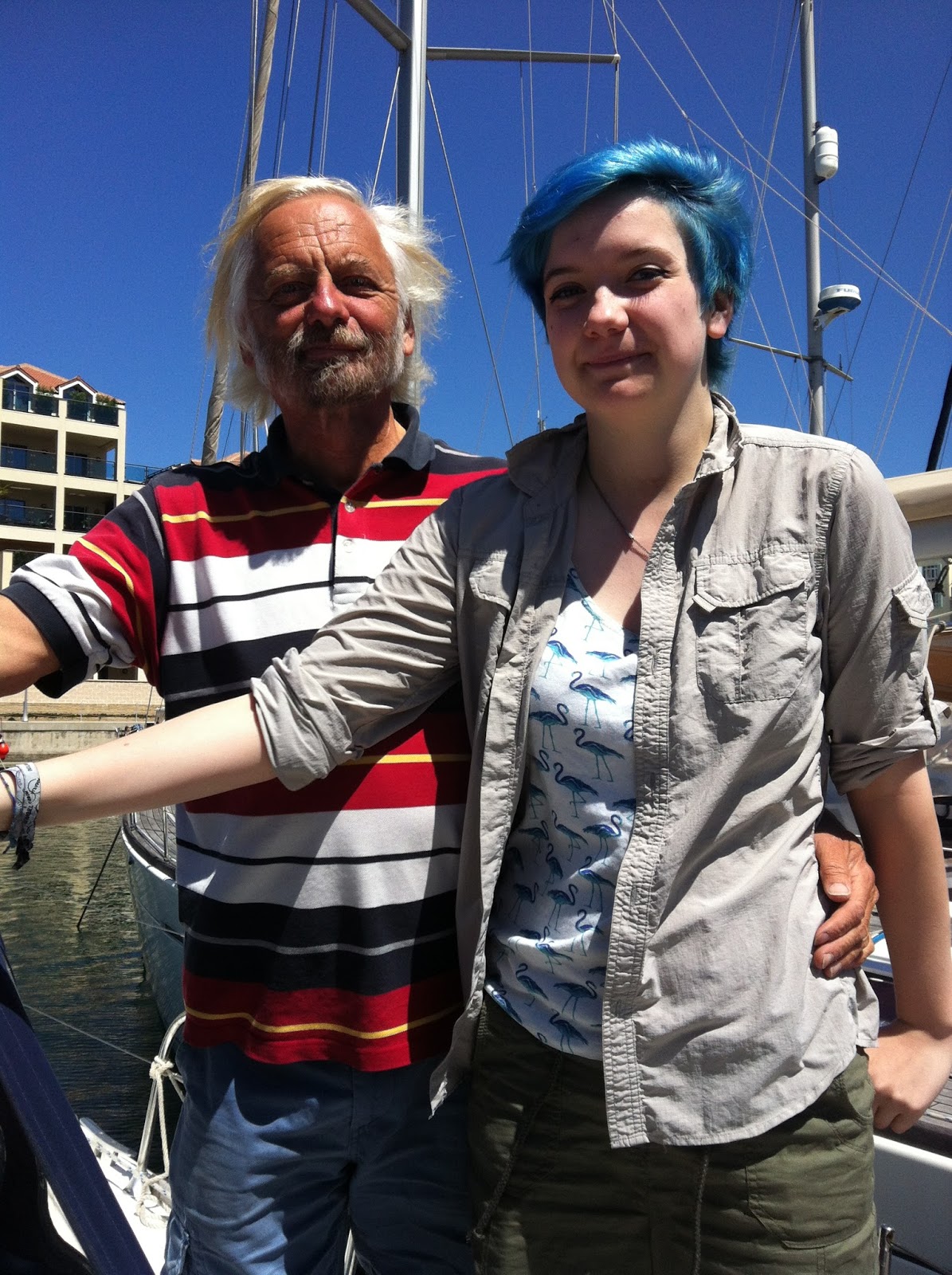
Daughter Mel, staying with us for a few days.

On arrival in Gib, we met with the electrician, fabricator and sailmaker and on Sunday 10th I flew back to Aberdeen, leaving Elsie in charge.

 If anyone thinks that sailing away is key to a stress-free life, they are bound for disappointment.  Maintenance is not only costly, but frustrating.  The parts that you want / need are unobtainable or out of stock; deliveries terminate in hidden depots and boatyards are long on promises but short on delivery.

Knowing that Ruby would be parked for a week, I had arranged for a large chandlery order to be delivered and spoken with (and emailed) Sheppards, the boatyard.  The latter had been invited to meet us at Marina Bay on our previous visit to confirm details but failed to turn up.  Despite being charged for Fedex service, our chandlery order was sent by ParcelForce.  It spent a leisurely 48 hours at Gatwick and then, on arrival in Gib, disappeared.  It seems that they considered their job done and sent a card advising its arrival to Marina Bay. This was filed under ‘don’t care’ and its existence denied in 3 phone calls.  It was left to Elsie to physically check their pigeon holes to find the card, seek out the ParcelForce office and lug 25Kg of goods back to the boat.  Included in this was a wind generator.  One of the major jobs to be done was making a pole for this to sit on and installing it.  With a week to go, Sheppards informed us that their fabricator was on holiday but, on the Friday, they did manage to get an independent contractor, and he (GibStainless) turned out to be very good.
We had a small tear in the mainsail, so this had to go away for repair with a request for a couple of other reinforcements to be made.  It was promised for return within 4 days.  When it was eventually returned, nearly 2 weeks later, the essential repair had been done and one of the reinforcements. Sam had also taken upon himself to make two modifications to the sail (to batten pockets and slide attachments) which were unwanted and potentially dangerous.  

We needed to be lifted for the prop anode bolt and decided that a job planned for the end of the year, replacing the time expired saildrive seal should be done at the same time.  On Monday 18th, we motored across the bay to Algeciras and were lifted out at Isla Verde.  Supposedly this was for 2 days but no-one was surprised that we were on the hard for a week.  While here we took delivery of a solar panel, planned for months and ordered 4 weeks earlier.  Of course, when it arrived it was wrong and a replacement had to be sent which, fortunately, arrived in time.  This was a replacement for an earlier one which had disintegrated and I was able to fit it myself.  At the time of writing it is working well, which is more than can be said for the wind generator which seems to be producing a fraction of its advertised power. [Edit – now working – hurrah]. Also included on the list of non-urgent jobs was a periodic check of injectors and valves on the main engine.  If any adjustment or replacement was required this would involve a delay of several days.  So, predictably and despite my entreaties, the specialist engineer did not appear until all other work had been done and we were ready to leave.  Cue boatyard manager looking disappointed at my impatience.

Ruby out of her element again.

Ruby was re-launched on Tuesday 26th.  The winds were light but we had missed the best tide of the day for re-entering the Med, so just motored back across the bay, this time sampling the marina at La Linea.  Very pleasant (and cheap) with shops to top up our cooking gas and food.

An early(ish) start on the 27th, to catch the tide and we were back on voyage.  The plan was to day sail back to the Marbella area but the forecast for the following week gave 36 hours of following winds and then nothing favourable for at least a week.  We decided to go for it and headed well out, to catch the wind, using just the genoa for the first 24 hours.  Unfortunately, the wind died after 24 hours leaving us with no handy suitable port so we motored, then motor-sailed the last 50 miles, arriving in Garucha at 1800 on the 28th.  I managed to sleep on voyage and Elsie ate, so we are definitely improving. 

The following day, we had a moderate NE’ly wind, which gave us an excuse to try out our ‘new’ stay sail.  The owner of a similar boat in Gomera reckoned that he found his ideal for sailing to windward and I managed to find a second-hand one which fitted perfectly at reasonable cost.  This cost was almost doubled by needing new cars for the jib sheet track but our experiments with the storm jib between La Graciosa and Madeira made us hope that it would be worth it.  First attempts were not promising.  Possibly, the inner stay was not tight enough; possibly we didn’t have the correct sheeting angle but we found that we could not point as high as using genoa alone.    We sailed 27 miles but only achieved 13 miles up the coast to Despena perros for our first night at anchor in over a month.  This was a lovely bay and would bear closer inspection, but I suspect that it is not cheap!. The shelter from the swell was not as good as we had hoped but both slept well.


On the 30th, the wind started very light so we motored for a couple of hours.  It then picked up and we had a pleasant beam reach to within a few miles of Cartegena.  There are 2 adjacent marinas near the centre of the town and, according to the pilot book, they are desperate for custom and eager to assist.  2 radio calls elicited no response.  We made our way into the newer marina, negotiating a dredger on 4 point moorings and a regatta of local craft using lateen sails.  No sign of marinieros.  We moored next to the fuel dock and asked people painting boat bottoms on the hard.  They pointed to a notice with a telephone number. This was answered by a man who asked me to call on the radio.  The same man answered and then appeared 2 minutes later.  It transpired that although we were in the basin for the new marina, he belonged to the old one and directed us back past the dredger and sailing regatta to our berth.  It was only 4 hours later that we discovered that it was party night with an open-air disco playing trance music until the not-so-small hours.  Ear plugs are wonderful things but could not prevent April ending with thudding heads.


And last place in the sailing race goes to...

Monthly stats:
logged           316
over ground  311

Saturday, April 2, 2016

March 2016

In which we sail back to mainland Europe in preparation for a summer in the Mediterranean. 

We started March at anchor of La Graciosa, the northernmost inhabited Canary Island.   Our weather planning had brought us here in the expectation of getting a favourable wind to take us To Madeira, the first leg of our journey back to the mainland of Europe.

The wind predictions continued to hold (for once) and at mid-day on the 1st we heaved up anchor and headed North West.  The predicted wind was NE’ly F4-5, backing to ENE’ly as we approached our destination.  Our intention was to swing a little to starboard of our track so as to keep the wind on our beam.  In fact, we found the wind to be coming from ENE on departure and kept it ahead of the beam, to avoid having to beat into it on arrival.  This meant a less comfortable sail, with a greater apparent wind, more heeling and more pounding into the waves but it was quite manageable and, after 36 hours, even Elsie claimed to be enjoying herself.  With the possibility of stronger winds, we had rigged the storm jib on the inner forestay and this proved very effective.  At night, Elsie sailed with just the storm jib and a 3 reefed main and achieved 5 knots across the ground.  Putting out a small section of the genoa increased our speed by over a knot and also reduced the rolling considerably.  The downside of this was fluttering of the leach of the genoa so, reluctantly we had to put it away to avoid any damage (on arrival, we tightened the leach cord on the genoa, and will experiment again).

Elsie had made up the after cabin again for this trip and this proved a good precaution as there was a leak from the hatch in the forward cabin.  We didn’t realise how bad this was until arrival, when we found that the bedding was completely soaked.  We feared that the seal needed replacing but investigation proved that the source was a perished O ring on a latch.

As we approached our destination the wind, instead of backing, veered, so that we could have had a much more comfortable journey.  So it goes.


We arrived in Porto Santo, the small island to the North East of Madeira at lunch time on the 3rd and tied up at 1400.  We chose here as 1, it is the nearest place to mainland Europe and 2, it is inexpensive: one week’s berthing cost 134 Euros but, if paid in advance, you get the rest of the month for free.  As we were unsure of when we would be able to move on, this was good news.  The staff are also very friendly and helpful, if a little inefficient.  Elsie managed to get all the bedding washed and dried in the first 48 hours and when it came to our personal laundry, leaving it next to an occupied washer resulted in the cleaner washing, drying and folding it – all for free!  The boatyard was a disappointment, proving unable to provide a tester for our suspect batteries or a piece of pipe to replace one on our domestic fresh water system with a pinhole leak, but the ever-helpful Zapatisto managed to conjure up an O ring that (almost) fitted the forward hatch, an auto-electrician to complete the re-wiring of our radar supply wire, a mobile diesel supplier to top off our tank and a replacement camping gas cylinder.  Even the Customs officer seemed to have done the customer service course and was charm personified.  Daily bread was available from the local café and an adequate supermarket was a mile away, giving us our daily exercise.

Each morning, we checked passage weather and Grib files (for the uninitiated, these are highly compressed files which can give a good overview of forecast winds).  Each day we agreed that six days’ time looked a likely date to depart, but we would need more information.  Finally, the departure date ticked down to 4, 3, 2, 1 day in the future.  On Monday 14th it looked possible:  Following 10-15 knot winds for the first 200 miles; light and variable for the next 100 and 10 knots on the beam for the run in.  It looked like it could be a slow passage with motoring required in the middle but very safe.  We carry fuel for about 300 miles but always want to have at least ¼ tank for ‘just in case’. 

So, with full fuel, water, stores and cooking gas we let go at 1015 on the 14th, bound for Lagos at the south west corner of Portugal, fully prepared to be at sea for a week if necessary.  Keeping us company was ‘Jaz’ another yacht bound for Cadiz.  We stayed neck and neck until her track finally took her too far south to see.  The wind, bless it, turned out to be 20 degrees backed from the forecast, which meant a broad reach rather than a run.  This gave us a more comfortable motion and an extra 2 knots.  Initially, with a F3, we had cruising chute and full main.  The wind had increased to F4 by 1800 and, foolishly, I kept the chute up for my evening watch.  I was regretting this by 2300, when the wind was gusting to 18 knots but didn’t want to disturb Elsie so left it until she rose at 2345.  Naturally, as we dowsed it, a stronger gust came, broke the weak link at the head and dumped it overboard, so it had to be dumped, wet, into the shower.  Changing to Genoa made no appreciable change to our speed.  Our education continues.

The wind continued SxWly F4-5 through to 1800 on the 15th, by which time we had covered 220 miles, averaging 7 knots, on a direct track and were within motoring distance so, when it dropped to F2, on came the engine.  The next 24 hours were alternately sailing and motoring though, as the wind was on the beam and the swell low, we could have progressed at 3 knots under sail.  By the following evening, the wind had steadied at N’ly F3 and we resumed sailing at 5-6 knots.

There is a huge traffic separation scheme off Cape St Vincent, which meant a 45 degree turn with 45 miles to go.  The wind obligingly turned with us and remained F3-4 on the beam.  We had full sail up as we crossed the end of the TSS but engine running too.  This gave us a reliable speed to assist in collision avoidance and also ensured that we would arrive in Lagos well before dark.  Sails down at 1615 with 465 miles run and still over ¾ full tanks.

Lagos marina turned out to be very pleasant (though a bit pricier than we had become used to).  There are many British boats staying winter or years.  The town itself is also attractive if a little touristy.   The chandlery, billed as one of the largest in Portugal proved a little disappointing but was able to supply the pipe required to repair the pin-hole leak on the domestic system.  We stayed 4 nights to recover, dry out the boat, watch the final day of the 6 Nations rugby and dry ourselves from that.

It was coming up to my next return for medical checks so we decided to plan on being in Gibraltar for the 10th April.  This would provide convenient flights and, hopefully allow some work to be done, particularly upgrading our battery charging options with a wind generator and a replacement for a defunct solar panel.  We left Lagos on the afternoon of the 21st for a short but pleasant sail to Portimao, anchoring overnight.  The following day, we wished to enter the lagoon off Faro, which meant arriving early afternoon to avoid 7 knot currents at the entrance.  The wind was initially too light to permit this so we motored for 3 hours until the coastal wind built at 1130 and gave us a good broad reach.  The lagoon has many mud flats and although our anchorage appeared, at high water to be in the middle of miles of open water, the falling tide told the true story.  The following 2 days were also spent more motoring than sailing: 53 miles to Mazagon on the 23rd and 36 to Bonanza on the 24th.  At the former, we anchored just outside the marina, in the shelter of a huge sea wall.  Bonanza is a few miles up the Rio Guadalquiver, which leads to Seville.  There is a strong current, but good holding and we spent a very comfortable night.  AS we were at spring tides, timing our exit was important, so we had a long lie, picking up anchor at 1030.  We expected to have to motor to the river mouth, but the wind was kind and we were soon progressing with all plain sail down the coast to Cadiz, tying up at 1700.

Cadiz from seaward

The centre of Cadiz is wonderful, with a huge area that has hardly changed for hundreds of years.  No chain stores, no plate glass windows and no advertising hoardings.  Every U.K. town planner should be made to come here to see what is possible and hang their heads in shame.  And where there are modern features, such as the bridge linking the peninsula to the mainland, they are stunning.  Even the pylons crossing the same gap are spectacular.  The only tatty bit is the dock area, leading to the marina.  Like so many parts of Spain (and Canaries) there are partially complete or abandoned projects that have been allowed to decay and get covered in graffiti.


We spent 2 nights in Cadiz before setting off down the coast early afternoon on Sunday 27th.  We had only 22 miles to go today and that was forecast to be the best timing for wind.  So it proved and we had a lazy sail down to Port Conil, where we anchored in what should have been the lee of the harbour wall.  Unfortunately, this seemed just to funnel the swell round and we had an uncomfortable night.

Our next challenge was the Strait of Gibraltar.  This is only 8 miles wide at its narrowest and not only does it have the only flow of water in and out of the Mediterranean, it also funnels the wind between the pillars of Hercules so there is great potential for 7 knot currents and gale force winds, with one of the busiest shipping lanes in the world to add to the spice.  I was having difficulty tying in the text advice in the pilot book with the tidal flow diagrams, so asked advice on the Cruising Association forum.  Collating the replies revealed that our best chance for the next week, and possibly much longer (as who knows what the wind was going to do after that) was to finish our coffee, pick up the anchor and go.  In fact, going 2 days earlier would have been even better, as it would have given an extra 90 minutes between best tides and sunset, but too late for that now.  So, at 1040, we heaved up and set off.  Had daylight been longer, we would have had time to sail all the way but, as I didn’t want a dark arrival we motored, or motor sailed most of the way to keep the speed up.  We didn’t pick up a following current until Tarifa, the start of the narrow bit, but from here on, with tide behind and a fair wind we sped through.  Gibraltar bay was packed with freighters bunkering, fishermen ferries etc. so we were pleased to be crossing it in daylight.  Our chosen parking space, Marina Bay, is right next to the airport runway, so we had to promise not to cross the centreline as it was active.

The marina itself is ‘Med style’: bow or stern to, with lazy lines to keep you off the jetty.  A fixed jetty works well in the Med, with no appreciable tidal rise but here, where it goes up and down a few feet, it presented access problems for Elsie.  We had planned to leave Ruby here while I flew back to the U.K. in April, but had a re-think and changed our booking to Queensway, where floating pontoons are used instead.

Gibraltar itself is all that we expected: touristy, historic, crowded.  We took the obligatory cable car to the top and went for a walk over the border to Spain.   Having motored so much in the previous week, we needed 130 litres of diesel, but at 28 pence per litre, it didn’t hurt too much.


Barbary ape

We had 10 days to kill, waiting for my booked trip to Scotland and decided to see a bit of the Costa del Sol, so set off again on the 31st for Marbella. The forecast was for 15 knots of wind; we planned for 20, with 2 reefs in the main and Genoa;  there was actually 25, so we had a spirited sail down the East side of the bay, round Europa point and up the coast.  Only on going inshore, at Jose Banus, did the wind change to light and variable and we had an interesting last few miles, alternating tacks, beating, running and reaching but tied up at Bajadilla at 1700, next to Jaz, the boat we had left Porto Santo with.  Timing on this coast is not so much about currents but seasons.  The cost of this marina was very reasonable, at 13 euros per night but from June to September, it nearly triples.  Ouch.  Let’s hope we can find some nice anchorages in the high season.

Monthly stats:
logged               931
Over ground    1004

Wednesday, March 30, 2016

Elsie's ABC of cruising - part 1

I saw this on someone else’s blog and thought it was a great idea. Writing down things that I love and don’t love as much about life on Ruby Tuesday. This blog is not only for other’s to read but it is also an account of our lives travelling around on the boat. It will give us something to read in our dotage. Help us remember places and incidents and bring back some of the pleasure of the journey we have done. Very sentimental I know but when I’m sitting in my wee knitted bed jacket with my blue rinsed hair and my falsers in a jar beside my bed and the nurse has just come back to empty the bed pan I want to have something to show her that I wasn’t always a bedridden forgetful old crabby woman. It’s our story.

A is for anchoring.
One of my favourite boatie things. Find a quiet spot and drop the hook. If there’s no wind stay for a few days and recharge your batteries. Lots of sun, sleep, food and time for maintenance. My favourite so far is San Francisco Bay in La Graciosa – a wonderful quiet anchorage which can hold as many boats as want to be there. It looks onto a huge sandy beach, which is unusual in The Canaries, and little volcanoes in the background. If you are feeling energetic a short dingy trip ashore and you can walk to the village a couple of miles away or up one of the volcanoes. The village has no paved roads, just sand tracks and the locals are so laid back they’re horizontal. The water is crystal clear for swimming. Even the tourist catamarans, which appear twice a day are just a form of entertainment. I wonder how many photographs I’ve spoiled by sticking out my tongue as they take photos of Ruby?
Don’t get me wrong, sometimes anchoring is a challenge and staying there can be from uncomfortable to downright unpleasant. Rolling is the worst. If the wind has been from a particular direction for a couple of days a swell will work up and if the anchorage is not sheltered from that direction you are in for a disturbed night. Two anchors sometimes works but not always – and it’s very hard work laying them, well, for Lionel it is, I just wind a bit and make appropriate noises now and again.
However, I’ll never be put off anchoring. Surrounded by cliffs, watching rainbows play on them, having conversations with people fishing from canoes, watching the antics of sheep and goats on vertical paths even avoiding intrepid swimmers. It’s a good life, drop the hook and watch the world go by.


B is for bullshit
You would not believe the amount of bullshit you can read or listen to about sailing and particular about cruising. Everyone is an expert and has an opinion on every aspect of life on the ocean waves. Don’t get me wrong, I have listened to some guys who actually know what they are talking about and have learnt some good things from them but others: *&*%$£!!!! I am learning to tune them out and not get angry but it’s a slow process. Sailing is a very individual sport. Every boat is different and every owner knows how to deal with things the best way on their boat. Yes, makes suggestions but because it works for you doesn’t mean it will work for someone else. No one is an expert on everything sailing. It’s worse for a woman too because male sailors can be very sexists. Two incidents spring to mind.
We were going into a berth in Tazacote marina, no great drama as the wind was light and we were all prepared. The skipper was taking it slowly as usual and I was standing midships ready to throw the line to the marineiro who was directing us. Along came this guy from the yacht next door and started yelling that we shouldn’t throw the midships line first it should be the spring. Now everyone ties up differently and that may be the best way to tie up his yacht but having done this a couple of hundred times I think I know the best way to deal with Ruby in a marina. I just carried on. He got louder and louder so eventually I told him I was following orders from “my skipper”. He didn’t like it. In fact we were there for a week and neither he nor his wife breathed a word to us which is unusual for boaties.
On a recent occasion a boat was coming in beside us on the next pontoon. Lionel and I went out to help them tie up as no official seemed to be around. Lionel caught the stern line and I took the bow one. I’ve never seen a man move so quickly when he realised a woman was holding one of his lines. He even trod on my foot to get to the line.
It’s still a man’s world when it comes to cruising and us woman are supposed to be quiet, listen and pour the drinks. As for having an opinion…….


C is for cruising
The best decision we ever made. A fantastic way to see the world. We set off from Inverness last March and it’s been a wonderful experience so far. Living on the boat took some adjustment, everything has to have its place as the space is so limited. We have now just about got Ruby organised and I can lay my hands on most things at a moment’s notice. It can be as slow or fast paced as you want. Find an interesting place and there is nothing stopping you stay there for days or weeks. Hit a boring coast line and do a long passage to get away from it.
The live-aboards we have met have been an eclectic bunch. Ranging from some young guys who are spending their student loans sailing across the Atlantic to old men who are bobbing about the Atlantic Islands enjoying their retirement. Most are like us, spending time out, seeing the world in a different way. It would be so easy to arrive in some of the places we have been to and stay there as a lot of people have done but there is still something pushing us along to see different places. We have found ourselves involved in a sailing community that spreads from the UK to New Zealand and that’s not bad for two self-confessed crowd phobic people. The people that we have met are all different, have different views on life, have different goals but the one thing we all have is sailing. Long may we be part of this community.


(to be continued)

Monday, February 29, 2016

February 2016

In which we end our winter tour of the Canaries, finishing up where we started.

We started February anchored off Montana Roja, Tenerife.  A nice, sheltered anchorage and it needed to be as a strong NE’ly wind blew for several days reaching F9, over 40 knots at times.  Books were read and I even managed to make a little progress with my Spanish.  The main beach was deserted but a little one tucked in the corner had its daily visits by hardy sun seekers.  There were also the occasional wind- and kite- surfers.  One of the latter gave us a minor drama one lunch time.  We watched him try, and fail, to get going after falling off and, after the 5th attempt decided that he wasn’t going to succeed and, as he was drifting towards South America, thought that we ought to do something.  We had started the engine and were about to heave up when the official rescuers from around the headland at Medano arrived on a jetski towing an inflatable tender.  Sheepish surfer returned to the beach.  That night, a SAR helicopter conducted a lengthy search operation in the area but we believe this was an exercise as there was nothing on the marine VHF or Navtex requesting assistance.

On the 4th, supplies were running low and the wind abated, so we decided to return to La Gomera.  We had a good start, running under just the genoa but, once more had to motor for a while before picking up a light northerly which brought us back to St Sebastian.  Theoretically, the parts for our headsail furling system should have arrived but we got increasingly strange messages as to their whereabouts. It transpired that, although the Canaries are happy to be part of the E.U. when it comes to grants for major projects, they are outside when it comes to imported goods.  They eventually arrived but I had to pay an additional 32 Euros: 23 to open the file and 9 excise duty, charged not only on the parts but also on the transport cost.  Theoretically, we could claim this back but the local official just scowled and went back to more important paperwork.  Having got the parts, fitting was a breeze and, for the first time, we were able to deploy and furl the genoa without using a winch (in light airs, at least).


                                                 Up the mast

We had returned in time for the local Mardi Gras Carnival.  Not quite on Rio’s scale but great fun.  Although there were daily visits by cruise liners, these were booted out before nightfall, allowing the locals to enjoy themselves without being swamped by tourists.  On Friday evening was the ceremony to pick the carnival queen.  The candidates had made incredibly intricate costumes, some mounted on lightweight gantries which they towed around the stage.  Most of the evening was taken up with musical groups.  These were of variable quality but equal enthusiasm.  Seemingly, to qualify for performance, each song has to mention ‘carnival’ in each verse and ‘La Gomera’ in the chorus.  Our favourite was the wonderful ‘Tronchi Ponchi Monchi’ group, who interspersed singing with the playing of trumpet shaped kazoos. 


                                         Carnival Queen.  She is towing this structure.

Saturday was the grand parade with grand floats, singing groups and drum bands.  Carnival queens, senior and junior were towards the front, with runners up following.  Every float appeared to have catering on board and at the tail of the procession small groups in fancy dress pushed covered supermarket trolleys.  The reason for this became apparent later.  Following the parade there was a gap of a couple of hours when each group had a picnic supper before the carnival ball, which went on until 5 AM.  We know the time not because we were present but because it was open air and only 100 meters from the Marina.  They even managed to drown out the noise from the generators on the ubiquitous ARMAS ferry.

Sunday was a rest day but Monday saw the talcum powder parade where everyone, wearing white, saunters through the town puffing talc in the air and on friends old and new.  The theme is continued into the evening with the talcum powder ball – a repetition of Friday’s dance but rather whiter.  We joined in, stripping off on deck on return and hosing down the following morning.


                                                                   Before


                                                                   After

Although it meant missing Friday’s ‘Internment of the Sardine’ (truly), we decided to move on on Wednesday and set off round the North of Gomera back to La Palma.  A spirited start into a NNW’ly F6, followed by a cracking beam reach with NE’ly F4 across to Santa Cruz.  The motion in the marina was as bad as before but we wanted to see the town so stayed 2 nights.  Santa Cruz, once away from the harbour, high rise hotels and MacDonalds is a very pleasant town still with local character among the tourist orientated shops.  The Carnival had obviously hit here too as the streets, cars, and shopfronts were covered in talc.  This meant that footing on steep, talc covered cobbles was somewhat precarious in places.

We had had enough rocking around by Friday and set off, once more, for Tazacorte.  Again, we went down the East coast, this time with just the genoa in a following F5-6.  This followed us round the bottom and we only had to motor a mile or so before finding a NNW’ly F2 which took us gently back to Tazacorte.

On our previous visit, we had identified a walk in the Tambuirente caldera, where you take a taxi to the top and walk down.  We had even done the first mile and back to ensure that it was suitable so on Saturday morning we took a bus up to Los Llanos and 2 taxis up to the top viewpoint.  The first 5 Km, descending gently through pine forest, was very picturesque.  The guidebook suggested 1.5 – 2 hours and we managed it in 1h 35mins so felt we deserved our picnic before the 7 Km leg.  This, it was suggested, would take 4 hours.  It was soon apparent that this trail was somewhat more challenging.  The first part (once we found it) took us down a steep path with hairpin bends to the valley floor and a dry(ish) river bed.   Unfortunately the bed was blocked at intervals by rock falls, necessitating scrambles on rocky diversion paths.  It was a footsore duo who emerged at the bottom car park 3h 55mins later.  Fortunately, there was a sign giving the number for a local taxi company and we splashed out on getting him to take us back to the boat.  On writing, 2 weeks later, we still have bruised toes from descending 3000 ft.  

We stayed in Tazacorte for a further week doing a little light maintenance, a little sun bathing and a little eating and drinking with the occasional walk up to the main village for provisions.  I still failed to persuade Elsie to visit the banana museum so we have an excuse for returning.


It was time to start thinking of moving on and back to mainland Europe.  There were forecasts of 2 periods of wind from the north, starting on the 21st and 26th respectively and we decided to take advantage of this by making two overnight passages: first to Santa Cruz de Tenerife and then to Lanzarote.  We departed Tazacorte at 0945 on the 21st and alternately motored and sailed up to the north of the island where we would find a nice F3 to take us across.  Not so.  We would have been content with the speed that the actual F2 gave us but, being beam on to the swell, we just rolled too much to keep the sails full and they slapped and banged so it was motor 6 hours; sail 6 hours and arrived at Santa Cruz at 1130 on the 22nd.  A nice marina, convenient for the city centre (or it would be, if the footbridge hadn’t been closed due to construction work).  Part of the reason for coming here was to solve a long running problem with the radar: the book says that it will work down to 8.7 volts, but it had been cutting out as high as 12.5V, easily reached on a long passage.  After much probing, we believed that it was caused by a voltage drop inside the chart plotter and had found the man who not only understood the system, but had the tools.  It turned out that the cause was two-fold.: poor design, in that there was a voltage drop inside the plotter (and it was inherent, checked by temporarily replacing PCBs); and poor installation, in that there was an excessive run of too small gauge of wire.  We managed to buy and run some suitable cable ourselves to get round the second part of the problem but Jose didn’t have time to connect it up for us so we still have yet to get it properly working.


                                    Snow on Tiede, Tenerife

The second leg of the passage, from Tenerife to Lanzarote, we too much rather than too little wind.  Leading up to departure, the forecast had increased from F4 to F6 but we actually encountered F7, inevitably during Elsie’s watch in the middle of the night.  Having become used to bumbling about the islands, we had become a little blasé about passage preparation and left the dinghy lashed on deck.  It got moved by a wave and we lost the seat overboard.  Lesson learned.  I also managed to break the oven door handle by grabbing it when rolling so have the entertainment of obtaining parts to be sent out to us.  The wind, although stronger than forecast, was from a good direction and we managed to achieve the perfect place for springing off on our next passage up to Madeira: la Graciosa, the small island at the northern end of Lanzarote.  Here we stayed, at anchor for the next few days with the forecast of getting a nice beam wind to take us up.

Monthly stats:
Logged  408

Over ground  404